Showing posts with label book review. Show all posts

Sunday, April 14, 2013

Three Mini Book Reviews


Frances & Bernard by Carlene Bauer. Has a letter ever changed your life?  When Frances and Bernard meet at an artists’ colony, they are not quite certain what to make of each other, but one letter changes everything. Bernard’s first letter to Frances leads to a deep and intense friendship. Not-so-loosely based on Flannery O’Connor and Robert Lowell, Frances and Bernard navigate the tricky waters of publishing, romance, religion, and mental illness in this hauntingly beautiful story. If you enjoy the works of Marilynne Robinson or 84 Charing Cross Road, or if you appreciate the bittersweet aspects of life, give this one a spin. 


The Mothers by Jennifer Gilmore. I had to remind myself several times while reading this book that it’s a novel and not a memoir—that’s how realistic and heartbreaking it feels. After years of unsuccessful fertility treatments, Jesse and Ramon desperately want to adopt a child, but they never could have imagined the difficulties lying in wait for them in the process, not least of which is determining how willing they’d be to adopt a child born with Down’s syndrome, fetal alcohol, blindness, deafness, spina bifida, or any combination thereof. This is an emotional and compelling read.


The Dinner by Herman Koch.  What starts off as a rather Bourgeois novel quickly takes a darker turn and descends into the realm of menace, both underhanded and overt.  Clearly there is more to our unnamed, mild-mannered narrator than first meets the eye, and as he learns more about his son’s new and disturbing hobby, the reader learns more about him.  The further this insidious father-son story unfolded, the faster I was compelled to turn the pages.  This book is a bestseller in Europe and recently translated for English-speaking audiences. 

~Emily

Wednesday, March 13, 2013

Book Review: A Tale for the TIme Being by Ruth Ozeki

For my job, I receive books every day with an editor's letter tucked inside, exhorting the 101 reasons why I should read that particular book.  (Why, yes, I do love my job. Thanks for asking.)  But what I do not receive every day is a book with letters from ten different editors around the world, exhorting the 1,001 reasons why I should love this book, and that's the first thing that made me sit up and take notice about Ruth Ozeki's new novel, A Tale for the Time Being. The ARC that Viking sent out included notes from editors in the US, UK, Canada, Spain, Brazil, Germany, Italy, Australia, Greece, and the Netherlands. I had not read Ozeki before, but I thought, "A-ha, clearly this is a book to be reckoned with."

And I was right.  Mostly I just want to heap superlatives on this book, but I'll try to tell you a bit about what the book is about, though that will be tricky.  Like the quantum physics that infuse (infuses? Is the word "physics" singular or plural?) the story, it's a book that alters as one reads and observes. Because a summary would be too complicated, I'm going to borrow the publisher's own marketing blurb here:
In Tokyo, sixteen-year-old Nao has decided there’s only one escape from her aching loneliness and her classmates’ bullying. But before she ends it all, Nao first plans to document the life of her great grandmother, a Buddhist nun who’s lived more than a century. A diary is Nao’s only solace—and will touch lives in ways she can scarcely imagine.
Across the Pacific, we meet Ruth, a novelist living on a remote island who discovers a collection of artifacts washed ashore in a Hello Kitty lunchbox—possibly debris from the devastating 2011 tsunami. As the mystery of its contents unfolds, Ruth is pulled into the past, into Nao’s drama and her unknown fate, and forward into her own future.
Nao has become one of my favorite narrators in literature.  She is very much in the vein of Midori from Haruki Murakami's novel, Norwegian Wood, which is to say she's bubbly, bright, and annoying-but-endearing. Her father is suicidal, and the cruelties she endures at the hands of her classmates (shockingly, with the tacit permission of her teacher) make every American YA novel about bullying look like a bonny good time. It's no wonder that she wants to follow in her father's footsteps and try to end it all.  Yet she has this wonderfully indomitable spirit and sense of humor that juxtaposes in a fascinating way with her avowed fate.

Jiko, Nao's great-grandmother, is also a terrific character. Though there are some secrets she has guarded all of her life, she serves mostly as Nao's sole source of stability and as such, she guides her in the way of  Zen Buddhism. Nothing Nao says or does can offend or surprise her, despite Nao's best efforts.

With the character of Ruth, Ozeki starts to break down fiction's fourth wall. Character Ruth splits her time between New York and an isolated island in the Pacific northwest, just like Author Ruth. Character Ruth is a practicing Buddhist novelist, just like Author Ruth. And the similarities go on.... Ruth (the character) is something of a Japanese scholar trying to defeat a bad case of writer's block, so her obsession with Nao's found diary becomes a way for her to sublimate her anxiety. Her husband is a quantum physics-quoting botanist, so there's that, too.

Top all of that off with the fact that Nao's diary excerpts as they appear in the book are amply footnoted for the benefit of a non-Japanese audience, and that the footnotes are attributed to Ruth--but is it Character Ruth or Author Ruth? It's hard to tell sometimes, and that's the whole point, I think.

I love the opening lines to Nao's first section. They put me a little bit in mind of the Emily Dickinson poem, "I'm Nobody!Who Are You":
My name is Nao, and I am a time being. Do you know what a time being is? Well, if you give me a moment, I will tell you.
A time being is someone who lives in time, and that means you, and me, and every one of us who is, or was, or ever will be. As for me, right now I am sitting in a French maid cafe in Akiba Electricity Town, listening to a sad chanson that is playing sometime in your past, which is also my present, writing this and wondering about you, somewhere in my future. And if you're reading this, then maybe by now you're wondering about me, too (p. 4).
I also love this: "I don't mind thinking of the world without me because I'm unexceptional, but I hate the idea of the world without old Jiko. She's totally unique and special, like the last Galapagos tortoise or some other ancient animal hobbling around on the scorched earth, who is the only one left of its kind. But please don't get me going on the topic of species extinction because it's totally depressing and I'll have to commit suicide right this second" (25).

And this bit about Nao's time living with Jiko at the temple:
They bowed and thanked the toilet and offered a prayer to save all beings. That one is kind of hilarious and goes like this: As I go for a dump/I pray with all beings/that we can remove all filth and destroy/ the poisons of greed, anger, and foolishness.
At first I was like, No way am I saying that, but when you hang out with people who are always being supergrateful and appreciating things and saying thank you, in the end it kind of rubs off, and one day after I'd flushed, I turned to the toilet and said, "Thanks, toilet," and it felt pretty natural. I mean, it's the kind of things that's okay to do if you're in a temple on the side of a mountain, but you'd better not try it in your junior high school washroom, because if your classmates catch you bowing and thanking the toilet they'll try to drown you in it. I explained this to Jiko, and she agreed it wasn't such a good idea, but that it was okay just to feel grateful sometimes, even if you don't say anything (167).
That gives you a pretty good flavor for Nao's narrative sections, equal parts earnestness and impishness. There is so much that is extraordinary about this book, but I fear I'm not doing it justice.  I think I will close with the blurb that I wrote up for Publisher's Weekly Galley Talk, as sometimes it's easier to say more with fewer words:

Zen philosophy and quantum physics blend seamlessly in Ozeki’s brilliant new work of metafiction, where sometimes it’s difficult to distinguish between the author’s attempts to build up and break down the fourth wall. Or as Jiko, the wise and wizened Buddhist nun from the book might say, “to raise or to raze, they are the same.” Jiko’s calm, hard-earned acceptance of contradictions contrasts brilliantly with the life of her great-granddaughter, Nao, a bullied schoolgirl with a suicidal father, adrift in a sea of emotions she is incapable of navigating. When Ruth, on the opposite side of the Pacific, discovers Nao’s diary among the post-tsunami flotsam and jetsam, she becomes obsessed with Jiko’s and Nao’s stories—to the point where she’s convinced that solving the diary’s puzzles will ease her restlessness and dissolve her writer’s block.  I’ve rarely encountered a novel that has made me think about our world quite as much as this one has, where distance and time are mutable depending on the observer, and what is a reader if not the ultimate observer? Ozeki’s novel feels, impossibly, both timeless and utterly of our time, but I suspect that might be the hand of Jiko guiding me. 

Ruth Ozeki will read at Odyssey Bookshop tonight, Wednesday, 13 March 2013, at 7:00 pm. We hope to see you there!  It is also our March selection for our signed First Editions Club.

~Emily

Wednesday, February 6, 2013

Book Review: After Visiting Friends by Michael Haines

(It's not your eyes--the photo on the cover is intentionally blurry)
Another friend in bookselling recently made a comment on her blog that there are just too many memoirs being published.  I tend to agree. She also went on to note that there are certainly exceptions to this rule. Again, I tend to agree. The problem with most memoirs is that the authors either don't have a good enough story to tell or they're not skilled enough to tell it well.  And don't even get me started on celebrity memoirs (Steve Martin's Born Standing Up being an exception to any rule. That man is a genius.).

So when I first saw the bound galley of Michael Hainey's After Seeing Friends, I was inclined to dismiss it.  Unknown author. Nondescript title.  I almost put it in the communal staff kitchen where all of the other unwanted galleys go, but then I saw who sent it to me: Wendy Sheanin, the adult marketing director at Simon & Schuster, whose tastes I trust.  And she'd tucked a handwritten note inside of the first page.  I'm a sucker for a handwritten note. And then I see an envelope hand-addressed to me tucked into the middle of the book.  Turns out that unknown-to-me Mr. Hainey is the deputy editor at GQ magazine and he's written me a note by hand on his letterpress stationery (I'm also a sucker for letterpress anything).

Naturally, After Seeing Friends made it into my tote to take home at the end of the day. Luckily for me, Mr. Hainey is possessed of a writing gift AND an interesting story to tell.  By the end of the first chapter I had dog-eared about half a dozen pages. That pattern continued throughout the book.  The GoodReads summary begins: "Michael Hainey had just turned six when his uncle knocked on his family’s back door one morning with the tragic news: Bob Hainey, Michael’s father, was found alone near his car on Chicago’s North Side, dead, of an apparent heart attack."

But was that the entire truth? Various obituaries in the city mention that the elder Hainey had died "after visiting friends," but who were these friends, and why didn't they attend the funeral? It is only when Michael has attained his father's age when he died that he decides to bring his full investigative journalism skills to bear to inquire into the circumstances surrounding his father's death. In Michael Hainey's search for what really happened the night his father died, it's not the 25-year-old cold trail so much as the stymying efforts of his father's former friends and colleagues that nearly prevent the story coming to full light.

Hainey travels from New York to the midwest and back so many times that I lost count, tracking down leads not only in Chicagoland, but in Nebraska, Iowa, Indiana, and many points in between. Along the way, the reader gets a front-row show to the golden age of Chicagoland journalism: old school, hard core, and with a code of honor that makes the Mafia look like they're merely playing at it.

Eventually Hainey does get the information he's after, and his main reward is that in losing his lifelong idea of what his father was, he is lucky enough as an adult to truly know his mother; the facade she maintains for her children's sake finally crumbles. For me, though, the real turning point of the story is when he reconnects with his cousin and older brother, and then later attends what would have been his father's 50th high school reunion, where he comes to know his father and where he himself fits within the generations of Hainey family. While Hainey's is a very specific and intimate story, there's an element of the universal permeating his quest: how can we know ourselves if we don't know where we come from? How can we know ourselves if we don't consider our impact on the next generation?

If you are interested in the nature of memory and how it intertwines with history, do yourself a favor and read this book. 

Some of the passages I enjoyed:

On visiting his grandmother in the nursing home: "I gave her a chocolate cream. She raises it to her mouth. A tongue emerges, takes the candy. Like a tortoise I saw at the zoo. She bites, almost in slow motion, chews so slowly I swear I can feel her tasting it ."

A description of Chicagoland as America's meat processing capital: "This was the land of Swift, the kingdom of Armour. It was the beauty of the Industrial Revolution's assembly line turned inside out. Chicago as the disassembly line. Chicago--how fast and how efficiently as creature could be reduced. Rendered. Broken down."

A terrible truth, laid bare, when he and his brother are told about their father's death: "In that moment I think only one thing: how excited I am. Because my whole life up until then, my bother has never cried. Whenever I have cried, he's always teased me, told me I was a baby. I point at him and start to laugh and I say, 'Cry-baby! Cry-baby!' "

"So often I wonder--Do all brothers end up at Kitty Hawk? Flipping a coin to write history. One will fly. The other stands slack-jawed with awe. Maybe chasing his brother. The wind in his face now. The wind that lifts his brother."

~Emily

Monday, February 4, 2013

Book Review: You Before Me by Jojo Moyes

Jojo Moyes' new novel Me Before You should come with a warning: do NOT pick this book up unless you have a box of tissues by your side and several hours to spare. Because once you start reading it, you're not going to want to put it down, and once you do put it down, you're going to be a soggy, wet mess. Believe me, my cat Murray was quite concerned with my state of mind. Then again, anything that interrupts the administering of chin scratches concerns him.

Up until the motorcycle accident that made him a quadriplegic, Will Traynor was both a go-getter and a player--wealthy, handsome, charismatic, and a thill-seeker to boot.  Lou, on the other hand, is from an economically challenged working class family--bright enough to have gained university admittance, but required to join the workforce to help her family pay the rent when her sister gets pregnant and her father gets laid off. When the cafe where she's been working as a waitress for the last several years closes, she desperately accepts a six-month contact taking care of Will. Will and Lou couldn't be more different on the surface, so when they form an uneasy alliance that grows into the truest friendship either has ever known, nobody is more surprised than they are.

The catch, and of course there's a catch, is that Will and his mother are keeping a secret from Lou, and when she discovers what it is, she reacts with her characteristic passion, matched only by her pigheadedness.  But might Will's secret haunt Lou to the point she makes the biggest mistake of her life?

Let me clear: this is not a book with complicated twists and turns that will keep the reader guessing.  If you pick this book up to read, you will have a fair idea of the story-arc before you're even fifty pages into it, as it's the story itself that pulls you in; but the class issues, the family relationships, and the importance of having somebody to believe in you when you no longer believe in yourself give this book a heft that matches its heart.


Tuesday, January 29, 2013

Book Review: Home Is a Roof Over a Pig

I find that most memoirs fall into one of two categories: a good story told by an okay writer, or an okay story told by a good writer, and Aminta Arrington's book falls into the former category.  Home is a Roof Over a Pig is her family's story of adopting a baby girl, whom they name Grace Amelie, from China and then moving there with their three small children in an attempt to give Grace a connection to her birth country. They also want their other two children to grow up with a wider world view than the typical American child's, as well as to give Grace's siblings a chance to know Grace's homeland and create a way for all of the children to share both American and Chinese identities.

Arrington's narrative style is mostly a conversational one and it serves her story well enough, though it does verge into the land of repetition on a regular basis.  It's when she tries to be more "writerly," for lack of a better word, that the writing really sticks out, but not in a good way. The chapters are more episodic rather than a linear narrative, and occasionally she jumps forward or backward in her timelines. That's okay, though, because her story is so interesting and unusual that I'd forgive the writing great deal more.

Aminta's husband Chris decides to retire from the military, giving them both a chance to re-invent their lives.  They can choose anywhere in the world to start over, and as Chris is facile with many languages and Aminta has always been interested in international relations, they know that the US is not where they want to be.  When Chris's older sons from a previous relationship move beyond their teens and their daughter Katherine is a baby, they decide to adopt a sister for her from China. During the adoption process, Aminta unexpectedly gets pregnant again with their son, Andrew, and soon the couple have three children under the age of three.

Now that Grace is a part of their family, deciding they should pick China as the place to raise their children is the easy part. The hard part is finding job placement for two adults with three small children, but in time a regional university in Shandong province called Taishan Medical College find teaching spots for Chris and Aminta, together with a tiny two-bedroom apartment in family housing. Though there are many frustrating moments when they doubt their decision to move to rural China, overall the family adapts fairly well to their new country, with the children adjusting in varying degrees and at varying speeds.  Soon they become entrenched in their neighborhood and in their teaching and church communities.

The title of the book comes from the Chinese character for "home," which Aminta learns is esentially the pictogram for 'roof' combined with the word for "pig," and that pig-farming was one of the earliest non-nomadic occupations for the ancient Chinese.  Thus, if you had a roof over a pig, you stayed put there and it was your home.  Learning tidbits about language like this is what made the book so fascinating for me. Like most Americans, I am not fluent in any language beyond my own, despite my own interest in language, dabbling in French, Spanish, and even Latin during high school and college, and taking an introductory course to linguistics in graduate school.  I may have no facility with it, but language has always interested me; learning a bit about a language whose characters are conceptual meanings rather than based on letters that combine into phonemes to create words was endlessly fascinating.

Beyond the language lessons, I especially enjoyed Arrington's stories about the young people taking her English classes--the cultural divides that become smaller and smaller as the book goes on, such as politics or the importance of family and maintaining cultural traditions, but also those that grow even wider, such as feminism, their respective views on Tibet, and the importance of independent thinking. Learning to understand (and respect) a worldview that is radically different from your own may be difficult, but both teacher and student know that it's essential to try, even, or perhaps especially, if you do not agree with it.

I'd recommend this book for people who are casually interested in China, international adoption, travel memoirs, memoirs about parenting or teaching, or simple readers looking for an unusual perspective.

~Emily

Friday, August 17, 2012

Book Review: Mr. Churchill's Secretary by Susan Elia MacNeal

Maggie Hope, born in England but raised in America, returns to her homeland to settle the estate of a grandmother she doesn't remember, where she must oversee the sale of her grandmother's house in order to fulfill the terms of the will. In the meantime, things are heating up all over Europe,  Hitler is cutting a wide and lethal swathe across the continent, and not enough folks are raising their voice in protest.

Determined to stay on in London, despite having to give up her PhD program in MIT's mathematics department, Maggie makes friends and takes in roommates to cover her cost of living while looking for work.  She reluctantly takes a position as a secretary at Number 10 Downing Street, knowing that her intellect could be better used as a codebreaker in the War Department rather than typing up the prime minister's memos.

There are two important people in Maggie's life who are not what they seem, and in a race against time, she must crack a German code hidden in plain sight and uncover their true selves before one of them is killed and the other one puts the entire city of London in peril.

I tremendously enjoyed this paperback original, which is the start of a new mystery series.  This book is fun and frothy, offering a little bit of everything: an evocative wartime setting, secret identities, gender politics, light romance, lots of gin drinking, a narrowly-avoided assassination, and a brilliant and saucy heroine.  Don't pick this one up if you're looking for something substantial, but if you like historical fiction or if you prefer you mysteries to be decidedly soft-boiled, give this book a spin.

~Emily

Monday, August 13, 2012

Book Review: The Dogs Stars by Peter Heller


I'm about six weeks removed from my reading of this book, and already it is as a distant memory for me, but I couldn't let the pub date come and go without saying something about Peter Heller's The Dog Stars.

This is the best book of the 20 or so that I read on vacation this year.  What's more, it may be the best book I've read this year.  What's even more, it just may be the best book I'll read in any year.

If you're reading this blog, you've probably already heard something about this book already--either because you're a customer and you've already heard me raving about it, or because you're a book person and you've heard the buzz surrounding this novel.  Which means what you probably know is that it's another post-apocalyptic vision of the world.  What you probably don't know is that it is also a beautiful one.

This may be a debut novel, but Peter Heller is no stranger when it comes to writing prose.  I don't think it's possible to produce a book like this one first time out of the gate.  His background in travel and adventure writing becomes clear once you settle into Dog Stars, but it's the prose itself that sets this book apart: strong, experimental, truncated, but with a stream-of-consciousness aspect to it.

This is the story of Hig, a one percenter.  Except in this case, he's one percent of the surviving population after a terrible flu has wiped out most of the population, and a mysterious blood disease has wiped out most of the flu survivors. He lives in a state of uneasy alliance with military-hardened Bangley, a "Survivor with a capital S," at a small, abandoned municipal airport.  With Hig's Cessna and a dog named Jasper, they create a perimeter than can be defended and protected against the marauding, near-feral almost-humans who occasionally cross their paths.

It's an uneasy alliance, but a successful one, until one day Hig hears another voice on the Cessna's radio, broadcasting from a place well beyond his gas tank's point of no return, and it's that voice that starts to haunt Hig's waking and dreaming moments: are there other pockets of other people out there like him, people who have maintained their humanity, but more importantly, their hope?

I won't say more than that, other than the rest of the book is dedicated to that search, but also to the preservation of that hope. Reading this book is a singularly satisfying experience, and one that drew me in deeply and was slow to let me go.  I laughed and I cried, and my pulse was pounding, often within the same chapter, and my husband tells me that all it took was watching me read the book to make him want to, too: he could hear my sniffles and my laughs, he observed all of my white-knuckled moments, my dog-eared pages, my deep sighs, and my blank looks when I stared, unseeing, out at the point where the ocean meets the horizon when the book became too much to take in.

Believe me when I say this book is a helluva read.

I'll conclude with a few excerpted passages and then the book trailer (sorry for the poor formatting--I don't know how to make it smaller).  I read this book in ARC form, but it was published this week by Knopf. Seriously, will you please just read this?

"Bangley never drank because it was part of his Code. I'm not sure if he thought of himself as a soldier or even a warrior, but he was a Survivor with a capital S. All the other, what he had been in the rigors of his youth, I think he thought of as training for something more elemental and more pure. He had been waiting for the End all his life. If he drank before he didn't drink now he didn't do anything that wasn't aimed at surviving. I think if he somehow died of something that he didn't deem a legitimate Natural Cause, and if he had a moment of reflection before the dark, he would be less disappointed with his life being over than with losing the game. With not taking care of the details. With being outsmarted by death, or worse, some other holocaust hardened mendicant (70)."

"I could almost imagine that it was before, that Jasper and I were off somewhere on an extended sojourn and would come back one day soon, that all would come back to me, that we were not living in the wake of disaster. Had not lost everything but our lives....It caught me sometimes: that this was okay. Just this. That simple beauty was still bearable barely, and that if I lived moment to moment, garden to stove to the simple act of flying, I could have peace (67)."

"Jasper used to be able to jump up into the cockpit now he can't. In the fourth year we had an argument. i took out the front passenger seat for weight and cargo and put down a flannel sleeping bag with a pattern of a man shooting a pheasant over and over, his dog on three legs, pointing out in front...I carried him. Lay him on the pattern of the man and the dog.

You and me in another life I tell him....

He's getting old. I don't count the years. I don't multiply by seven.

They breed dogs for everything else, even diving for fish, why didn't they breed them to live longer, to live as long as a man (23, 24, 25)."


Peter Heller's The Dog Stars is a selection for the Odyssey Bookshop's signed First Editions Club.  He'll be reading at our store on Friday, September 28, and we couldn't be more excited!

~Emily

Thursday, July 26, 2012

Chris Bohjalian's The Sandcastle Girls

While the emotional content of this book is trademark Bohjalian, the writer takes on a new depth and historical perspective in Sandcastle Girls that is not usually present in his more formulaic novels. Unsurprising, since this novel is the first that delves into his own history.

The little I knew about Turkish-Armenian relations came from working at a used bookstore, where a customer of mine bought up everything he could on Armenia. Occasionally he would toss out historical facts but eventually I learned it was a topic he didn't want to fully engage in, so it was fascinating to read this book as a first attempt to fill in some of the historical blanks. 

(Incidentally, this is the third novel of genocide I've read this year: Rwandan, Cambodian, and now this one, which I guess means my taste run to the dark side, at least when it comes to historical fiction. It also happens to be the fourth novel in a row that I've picked up that features a Muslim/Christian conflict, so it's interesting to me to see these unconscious reading patterns of mine.)

The novel has two main time frames. One is a contemporary, middle-aged first person narrator named Laura living in NY who investigates her Armenian roots and reminisces about her childhood. The other is a third person narration that begins in Aleppo, Syria, in 1915, mostly following Laura's paternal grandparents Armen, an Armenian engineer who has survived the Turks' first onslaught against his people, and Elizabeth, a Bostonian blueblood who has traveled to Syria with her father to give aid and succour to the refugees. Occasionally the narration darts over to Nevart, a widowed refugee, and to Hatoun, an orphan who has witnessed such unspeakable atrocities against her family that she has become practically mute herself, as well as other, more minor characters.

War casualties are awful things and this novel's World War I setting proves no exception, but it's particularly difficult to read of the crimes perpetuated by the Ottoman Empire against some of its own civilians, and the twisted logic and false rhetoric they use to justify their actions is simply appalling.

I can't possibly pretend to know or understand the centuries-old history between the Turks and the Armenians, or how the Ottoman Empire selected the Armenians for extermination over all of the other peoples under its sway. But there is a portion of this novel presented as fact, and if it's true, then it's utterly galling, and I will excerpt some of it here:

"If you visit Ankara or Istanbul today, you will find streets and school named after Talat Pasha ["the real visionary" behind the Armenian genocide]....In other words, the nation that found Talat Pasha guilty of attempting to wipe out a race of people later named concourses after him.
   How is that possible? Because, to much of the nation--though, thankfully, not all--that genocide never happened. Even now, labelilng the slaughter of 1915 "genocide" can land a Turkish citizen in jail and get a Turkish Armenian journalist killed (179)."

If that is true (and Bohjalian did not footnote it or document it, so I don't know), then it really blows my mind.  It's impossible to imagine the German citizens of today wanting to glorify Adolf Hitler in a parallel manner, renaming any of the schools or thoroughfares for him. How is it possible that the citizens of Turkey are, as a nation, able to do so?

Chris was at the Odyssey last night to do a reading and presentation from The Sandcastle Girls, and he's as fine a speaker as any who have passed through this store.  If you missed it, let us know and we can reserve a signed copy for you!

~Emily

Wednesday, July 25, 2012

Book Review: The Uninvited Guests by Sadie Jones

It's Emerald Torrington's birthday and she's planning a lovely party for herself, her family, and some intimate friends, when nearby tragedy strikes: there's been a railway accident and Emerald's home, Sterne, must give shelter to a couple dozen of the third-class carriage survivors, as it's the closest country estate, and "needs must," as they say. Meanwhile, her one-armed stepfather has driven to town to try to save the estate, the neighboring tenant farmer may or may not be wooing her, her surly and spoiled brother has made an inappropriate friend, one of the maids has called in sick, and her younger sister is gripped with the urge to sketch her pony in charcoal on her nursery wall, in situ. What could possibly go awry?

This book started off with a bang: think Downton Abbey with an overlay of more overt humor, reminiscent of P. G. Wodehouse.  Or, if you prefer your pop cultural references to take a more cinematic turn, the whole story reminded me much of the wayside travelers in the movie Clue, the ones who happen upon the great house seeking shelter from the dark & stormy night. Then things take a decidedly strange turn, and (spoiler alert--highlight the next line with your cursor to make it easily readable)   lo, it turns out that my instincts that screamed ZOMBIE! were not entirely off.  That's all I'm saying now, because nothing else I've read about the book prepared me for that aspect of it, and heaven forbid that I ruin things for another reader. 

It is funny, and it is bizarre, and by the time you come to the end, like any good English period drama, nobody is saying what they mean, much less acknowledging all of the things that went bump in the night.

Here's a fairly representative humourous scene from the beginning of the book, where Emerald's mother and the housekeeper are discussing one of their dinner guests. I'm sure you can guess which one is the self-serving and generally useless mother and which is the servant from the dialogue:

'Oh, I see. A scientist." This last was said in tones of dreary condemnation.
'With red hair.'
'Lord, yes. And a squint.'
'That's the fellow -- spectacles.'
'Hardly his fault.'
'You might say that, Florence, but although many may need them, only a certain type of person wears them. I prefer a passionate, squinting man than one who corrects his sight with wiry little spectacles and is in command of himself.'
Indeed!

~Emily

Tuesday, July 24, 2012

An amazing read: The Unlikely Pilgrimage of Harold Fry

I first heard of Rachel Joyce's debut novel a few months ago--folks on Goodreads were talking it up, and so was my Random House sales rep.  Then, in early June at BEA, it had earned one of the coveted spots on the Editors' Book Buzz panel, where I was lucky enough to snag a copy of it.  I had a hunch that it would make its way into my suitcase for vacation reading, and test-driving the first chapter proved that hunch correct. As it turns out, it provided me one of the most enjoyable vacation reads I've ever had!

Over breakfast one day, recently retired pub man Harold Fry receives a letter informing him that his old friend and colleague, Queenie Hennessey, is dying of cancer. He struggles to write a response, without knowing quite what to say, and he walks out of the house to post it at the closest letterbox.  The thing is, when he reaches it, he thinks he can come up with a better response, so he keeps walking to the next letterbox. Then the next one. Then the next one.  Once he recovers from his reverie, of what to write, he realizes he's walked out of the village.

Stopping at a petrol station, a chance encounter with a young employee there convinces him that really, the best way to do this thing is to deliver the message to Queenie in person, no matter that Harold isn't a walker, he's not in very good shape or wearing appropriate shoes for the endeavor, that Queenie is over 500 miles away, or that Harold's wife, Maureen, might have something to say about his decision. Instead of turning homeward to retrieve suitable items for such a journey (oh, you know, things like maps, water, his mobile, and a sense of direction), he calls his wife from the station to announce his intentions and heads out in a direction that he hopes is northerly.

Along his journey, Harold finds support and succor in the unlikeliest of people, and before long his pilgrimage attracts nationwide attention and more than a few hangers-on.  As he learns to just keep putting one foot in front of the other, no matter what the terrain or the state of his poor, blistered appendages, he has plenty of time to meditate on his life, his marriage, his son, his friendship with Queenie, and how he's mostly made a muck of things. At home, Maureen undergoes similar bouts of introspection, and discovers, much to her surprise, that one by one, she has gradually revoked a lifetime of recriminations towards Harold.

This is a book that has so many funny things on the surface that it might be easy to miss the emotional depth and universal human insights that it provides.  While I definitely laughed out loud while reading of the hapless Harold's exploits, more than once was I moved to tears by the wave of humanity that Joyce readily taps into.  Most of the reviews I've read of this book compare it to Major Pettigrew's Last Stand, and while I can see that to a certain degree, I think the more appropriate comp is The Tower, the Zoo, and the Tortoise, where the whimsy of that peculiar ensemble of characters is matched only by the poignancy the story ultimately delivers. I also love that it's a book whose main characters are all of retirement age: there seem so few really good books who feature that demographic that it always stands out when I encounter it.

To say more would spoil the sense of anticipation that I'd want any reader to have when embarking on this novel, so instead I'll just share a few passages that resonated with me as I read.  But please: do yourself a favor and find a copy of this book to read asap! The book releases in the US today, and you can come by the store to pick one up, or call/email/visit our website to order one.

"The kindness of the woman with food came back to him, and that of Martina. They had offered him comfort and shelter, even when he was afraid of taking them, and in accepting he had learned something new. It was as much of a gift to receive as it was to give, requiring as it did both courage and humility."

"He wished the man would honor the true meanings of words, instead of using them as ammunition."

"He wished no one had mentioned religion. He didn't object to other people believing in God, but it was like being in a place where everyone knew a set of rules and he didn't. After all, he had tried it once and found no relief. And now the two kind ladies were talking about Buddhists and world peace and he was nothing to do with those things. He was a retired man who had set out with a letter."

~Emily

Friday, May 11, 2012

Book Review: Billy Lynn's Long Halftime Walk

Book Summary: Told over the course of a single day--specifically Thanksgiving Day at Texas Stadium, as the Dallas Cowboys take the field--Billy Lynn's Long Halftime Walk is the story of Bravo Squad, eight survivors of a ferocious firefight with Iraqi insurgents, whose bravery and and valor have made them national heroes. In the final hours of their Pentagon-sponsored "Victory Tour," Bravo's Silver Star-winning hero, nineteen-year-old Billy Lynn, will confront hard truths about love and death, family and friendship, war and politics, duty and honor.

This is one of the best books I've read all year, and one that I'd say is a real contender for 2013's round of major literary awards. The writing is terrific, and I feel that in addition to being a fresh and edgy book, this may be an important one. So far it's the only one I've read coming out of the Iraq War that subsumes itself in neither action sequences nor in an overwrought family or romantic drama. Instead it seems to be just as much about the concept of war itself as the politics behind it and how America feels about it. (Though given the book takes place mostly in Texas, especially Dallas, we're not really given a look at the dissenters' side of things.) 

Billy Lynn is a fascinating character, a boy thrust into the army (in lieu of doing hard time) after taking a crowbar to his sister's ex-fiance's car for gallant but misguided reasons. He's a thoughtful young man, fully aware that the labels of "hero" mean nothing when one's actions are guided neither by bravery nor fear, but are simply reactionary to any given situation, including Bravo's famous firefight with the Iraqi insurgents: one day you're the hero and the next day you're cowering under your humvee and refusing to come out. His thoughts are never far away from his imminent return to Iraq, nor from his buddy, Shroom, who died the day Billy was labeled a hero.

Ben Fountain's novel is also the first book coming out of the Iraq War (that I've read, at least) that seems willing to say that war is, more than anything else, a commercial enterprise. It's difficult not to draw these parallels about the US's involvement in Iraq with, say, the Dallas Cowboys franchise and the oil-steeped politics of the state in which the book is largely set, or the larger-than-life characters we meet, such as the Dallas Cowboys' owner or the man who spends the book negotiating a movie deal for Bravo. War as commercially motivated enterprise, not a political one, isn't a new concept per se, but it goes a long way in increasing this particular reader's distaste for it, because if it's really not about oil, really not about protecting our interests, and really not about freeing a people from their dictator's rule, then it's really not something I can ever understand, or wish to, for that matter. What's more, Fountain seems to be suggesting that, despite whether they're for or against the Iraq War, that most Americans only monitor it from the comfort of their living sofas, and thus we have an enterprise reduced to entertainment television.

Karl Marlantes blurbs this book, and he's not a writer whose opinion I take lightly, especially when it comes to the topic of war. He calls it "the Catch-22 of the Iraq war," and with a comment like that, I'm not sure that there's anything more to add.  I'll just conclude with some passages that resonated with me as I read it:

"So they lost Shroom and Lake, only two a numbers man might say, but given that each Bravo has missed death by a margin of inches, the casualty rate could just as easily be 100 percent. The freaking randomness is what wears on you, the difference between life, death, and the horrible injury sometimes as slight as stooping to tie your bootlace on the way to chow, choosing the third shitter in line instead of the fourth, turning your head to the left instead of the right. Random. How that shit does work on your mind (26-27)."

"Those people [movie studios, producers, etc], the kind of bubble they live in? It's a major tragedy in their lives if their Asian manicurist takes the day off. For those people to be passing judgment on the validity of your experience is just wrong, it goes beyond wrong, it's ethics porn. They aren't capable of fathoming what you guys did (57)."

I love this moment between Billy and his sister Kathryn, re: their father:
" 'He's an asshole,' Kathryn said. 
To which Billy: 'You just now figured that out?' 
'Shut up. What I mean is he likes being an asshole, he enjoys it. Some people you get the feeling that can't help it? But he works at it. He's what you'd call a proactive asshole' (75)."

Billy with his nephew on leave:
"Based on his highly limited experience with small children, Billy had always regarded the pre-K set as creatures on the level of not-very-interesting pets, thus he was unprepared for the phenomenal variety of his little nephew's play. Whatever came to hand, the kid devised some form of interaction with it. Flowers, pet and sniff. Dirt, dig. Cyclone fence, rattle and climb. Squirrels, harass with feebly launched sticks. 'Why?' he kept asking in his sweetly belling voice, as pure as marbles swirled around a crystal pail. Why? Why? Why? And Billy answering every question to the best of his ability, as if anything less would disrespect the deep and maybe even divine force that drove his little nephew toward universal knowledge...So is this what they mean by the sanctity of life? A soft groan escaped Billy when he thought about that, the war revealed in this fresh and grusome light. Oh. Ugh. Divine spark, image of God, suffer the little children and all that--there's real power when words attach to actual things. Made him want to sit right down and weep, as powerful as that. He got it, yes he did, and when he came home for good he'd have to meditate on this, but for now it was best to compartmentalize, as they said, or even better not to mentalize at all (82-83)."

The reader never gets the full picture of exactly what happens to earn the Bravo Squad their Victory Tour back home, but here is one of Billy's ruminations on it: "All your soldier life you dream of such a moment and every Joe with a weapon got a piece of it, a perfect storm of massing fire and how those beebs blew apart, hair, teeth, eyes, hands, tender melon heads, exploding soup-stews of shattered chests, sights not to be believed and never forgotten and your mind simply will not leave it alone. Oh my people. Mercy was not a selection, period. Only later did the concept of mercy even occur to Billy, and then only in the context of its absence in that place, a foreclosing of options that reached so far back in history that quite possibly mercy had not been an option there since before all those on the battlefield were born (125)."

Read this book.  Seriously, just read it. And if you don't want to take my word for it, check out this superlative review from The New York Times earlier this week.

Billy Lynn's Long Halftime Walk is the Odyssey Bookshop's May selection for its First Editions Club. Ben Fountain will be reading at the store tonight, May 11, at 7:00 pm. 

~Emily

Thursday, May 10, 2012

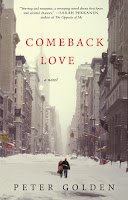
Book Review: Comeback Love


I just love the publication story of  Comeback Love by Peter Golden.  I was talking with John Muse, my sales rep from Simon & Schuster a couple of weeks ago about this book, which he "discovered" as a self-published book from the Book House in Albany. They're a wonderful indie bookstore with their own Espresso Book Machine and they offer publication possibilities for local authors. John was so impressed with the book that he pitched it to his own company, who eventually bought the rights to it, and Washington Square Press published it about one month ago. I love publishing success stories like that, and when I personally know any of the players involved it makes it even better.

Gordon and Glenna had an amazing love affair at the close of the 1960s, but their relationship was no match for Gordon's financial insecurities and Glenna's personal ones.  The political verve that marked those years also marked the beginning of the end of their love, with Vietnam pinning them in on one side and Glenna's illegal abortion activities hemming them in on the other.  Still, Glenna and Gordon never forgot each other, but when decades later Gordon decides to look her up again, the temptation to settle back into the same old patterns is strong.

I thought this was a very readable and pleasant story of first love and love renewed.  I'm almost exactly midway between the ages the characters are at the beginning and at the end of the novel, and it was interesting to me to feel similar levels of sympathy toward the younger and older selves of the couple. I wouldn't exactly say that this book changed my life, but it did encourage my mind to wander paths of nostalgia while I was reading. It even prompted me to dream about my own first love (cheers, M, wherever you are!), which I suppose is a testament the story and the power of memory.

This would make a good book club discussion book, particularly if the readers are closer in age to the older Gordon and Glenna.

~Emily

Monday, May 7, 2012

Book Review: Heading Out to Wonderful

I admit up front that I was not a huge fan of Robert Goolrick's previous novel The Reliable Wife, so I was a little reluctant to pick up his new one called Heading Out to Wonderful.  Luckily I had a little prompting from Craig "Call me Peaches" Popelars at Algonquin, who told me that he thought I'd love it. As usual, he was right. Damn his eyes.

If you read enough books or watch enough movies, after a while you develop certain expectations built into certain plot points. Thus, in chapter one when a mysterious drifter rolls into a small Southern town with nothing but his truck and two suitcases, and when those two suitcases are filled with nothing but cash and a set of the sharpest butcher knives anyone has ever seen, you know that by the last chapter there's no way that everything can end well.  Just a fact of fictional life.

That's essentially what happens in Goolrick's book, but he does stand certain of the reader's expectations on their heads, and that's what makes for an intense but heartfelt read.  You know something bad is going to happen, but it's not precisely clear at first just what path the badness is going to take: will somebody end up butchered & barbecued, a la Fried Green Tomatoes? Will the evil spring from the handsome stranger, or will it be exacted upon him by the small, xenophobic town? Is the handsome stranger's intense relationship with the young boy more insidious than it appears on the surface or is it completely innocent?

Add in a curious five year-old narrator, a small town full of busybodies, a racial divide, old time religion, a near-death resuscitation, and a man who's so rich and so mean, he has to buy himself a pretty young mountain girl for a wife, and you've got the makings of a pretty great story. 

The opening paragraphs are some of the best meditations on memory that I have ever read. The book is narrated by Sam, who is an old man looking back on what happened when the drifter came to town and his family took him in:

The thing is, all memory is fiction. You have to remember that. Of course, there are things that actually, certifiably happened, things where you can pinpoint the day, the hour, and the minute. When you think about it, though, those things mostly seem to happen to other people.

This story actually happened, and it happened pretty much the way I'm going to tell it to you.  It's a true story, as much as six decades of remembering and telling can allow it to be true. Time changes things, and you don't always get everything right. You remember a little thing clear as a bell...while other things, big things even, come completely disconnected and no longer have any shape or sound. The little things seem more real than some of the big things....I'm  not young any more, so sometimes I can't tell what things are the things I remember and what things are just things that other people told me They tell me things I did, and a lot of them I don't remember, but most people around here aren't liars, so I just go on and believe them, until it seems that I actually do remember the things they say.

This is not exactly a Southern gothic tale, though  it has elements of that.  Mostly it's the story of quiet people after the war, who are on the cusp of modernity and who know their simple, seemingly charmed way of life won't last forever.  It's the story of otherwise good people who choose to let evil into their hearts, and the blinding love of a small boy for a man he calls Beebo, who instinctively knows something about protection but is too innocent to understand what happens around him. I highly recommend it. I've already passed my reading copy on to my husband and he's barely spoken to me since--that's how involved he is with it. 

~Emily

Tuesday, April 3, 2012

Grave Mercy by Robin LaFevers

So, this is Tuesday, which means Day-of-Awesome-Book-Releases, and today I want to mention a book that both Marika and I have read.  It's called Grave Mercy, written by Robin LaFevers, which is the first book in the His Fair Assassin series. Marika was lucky enough to get a manuscript direct from the publisher, while I had to content myself with a plain bound galley given away at the New England Independent Booksellers Association last fall.  No matter, because the tagline is so groovy that I knew that I would have to read it right away: Why be the sheep when you can be the wolf? Why, indeed.

It's a rollicking good read, set in 15th century Brittany.  Ismae, marked from birth as the devil's child, passes from the hands of an abusive father to those of an abusive husband without so much as a by-your-leave, but a mysterious person comes to her rescue that eventually leads to convent of St. Mortain, one of the old gods of yore. There Ismae learns the dark arts and becomes assassin and handmaiden to Death himself.  Yeah, that's right.  Did I mention the part where I said it was rollicking? And outrageously fun?  And sinfully distracting from any real world problems you might be experiencing?

But you know the best part?  Marika read the manuscript so early and liked the book so much that her blurb is featured on the back of the dust jacket!  She says, "A romance full of intrigue, poison, and ultimately finding one's way, His Fair Assassin will be a trilogy readers of all ages will gobble up."

Because the Odyssey loves this book so much the publisher, Houghton Mifflin, has given us t-shirts and buttons to give away to everybody who purchases a copy of Grave Mercy, while supplies last.  The red tees and the white buttons both feature the tagline, Why be the sheep when you can be the wolf?

~Emily

Friday, March 9, 2012

Not Your Father's Nonfiction

Here are a pair of brand-new nonfiction books that I've read recently and recommend; I mostly read fiction, and when I do delve into the nonfiction world it's usually of the narrative variety, but these two are outside my usual reading realm. That being said, they were both absolutely fascinating!

The Lifespan of a Fact by John D’Agata and Jim Fingal.  This book is endlessly fascinating!  I had no idea until I read The Lifespan of a Fact exactly what happens behind the scenes of any responsibly published nonfiction piece. This book was born out of an article by John D'Agata that had a few too many factual inaccuracies to get published by mainstream periodicals. Enter Believer magazine, who was willing to publish the article as long as they could determine where facts left off and fiction began. They put their staff fact checker Jim Fingal on the job, and some years later, the article was finally published. Now Norton has published this wonderful behind-the-scenes book, with D'Agata's article intact, printed in black, and surrounded by the fact checking correspondence, much of which is printed in maroon.  It’s clear to me after reading this book that the unnamed fact checkers are the unsung heroes of the publishing world, no matter where we draw the line between journalism and creative nonfiction, and I’ll never take them for granted again. Take a look at this book that is both intriguing to read and a beauty to behold. 

The Storytelling Animal: How Stories Make Us Human by Jonathan Gottschall.  I was surprised upon picking up this book to see how much our lives are defined by story: there are the expected books of course, but also tv, movies, jokes, commercials, lies, gathering ‘round the water cooler, and even sports events; really, the list goes on. Gottschall delves into the fascinating evolutionary, cultural, biological, and even neurological reasons why our species is defined by our storytelling, both communal and individual.  This is by far the most compelling non-narrative nonfiction I’ve read in simply ages, and what’s more, it should be required reading for every single reader and writer out there. This book will be published by Houghton Mifflin Harcourt in a few short weeks, but it's available for pre-order now through our website or by calling the store. 

Tuesday, March 6, 2012

Terrific Tuesday: Song of Achilles by Madeline Miller

We've been madly busy updating our new website and selling Rachel Maddow tickets (hurry--they're almost sold out!), but I couldn't let one of my favorite spring books go unremarked on the blog today.


Wow.  Amazing. Stupendous.  Beautiful.  Heartbreaking.  

Okay, is that enough of a review for debut novel The Song of Achilles, by classics scholar Madeline Miller?  Because I feel that anything else I say about it won't do it justice.  It's astonishing.  The writing is marvelous. The characters, like Athena from her father's head, leap fully-formed from their pages.  

All right, I'll at least try to tell you what this book is all about.  In Miller's words, from the back of the advance reading copy I read: "I had always been especially moved by Achilles, and his desperate grief over the loss of his companion Patroclus. But who was Patroclus? I searched the ancient texts for every mention of his name and discovered an amazing man: exile and outcast, loyal and self-sacrificing, compassionate in a world where compassion was in short supply.  I had not thought The Iliad had a love story; I was wrong."

Song of Achilles, then, is the story of Achilles and Patroclus, narrated by the latter.  It's a love story and a war story, and these twin narratives weave in and around each other to the point that they're impossible to separate. This is like no book I've read before! I never would have thought that there was any book that could both keep me up all hours to finish it AND send me straight to the bookstore to purchase a copy of The Iliad to read back-to-back with it. This book is beautifully imagined and written. Clearly the Greek classics are NOT dead, not with Madeline Miller at the helm. Brava! 

On a completely random sidenote: the character of Odysseus is *exactly* like what Remus Lupin would have been like, had he been sorted into Slytherin.  So yes, Odysseus is the amalgamation of my favorite two DADA teachers!

I raved about this book to my husband, which piqued his interest.  Then I forced suggested that he read it on vacation last week.  He did and he was a bloody mess about it.  The story engaged him to the point that he was distant over dinner conversation.  And forget about talking to him in the wake of the conclusion--he was a weeping shell of a man* over breakfast that morning!  I trust I don't really give anything away when I remind readers that Greek stories are usually tragic or comic, and that this one ain't comic, and we know what happens in tragedies. 

Now I'm off to go read Homer and his many epithets.... 


Madeline Miller will be at the Odyssey on Wednesday, March 21, at 7:00pm.  We hope to see you there!

*not that there's anything wrong with being a weeping shell of a man, or the fact that it was pretty much hard to differentiate that morning from any other day, given that weeping is actually a distinguishing feature of my gentle-souled DH. Hey--that's not a bad epithet, come to think of it!


~Emily

Monday, February 13, 2012

Audio book review: Juliet by Anne Fortier


I actually borrowed this audio book from my mother, for whom I had bought it about a year ago when I saw it on the bargain table at my bookstore.  When I was visiting her over the Christmas hols I noticed that she hadn't listened to it yet, so I helped myself to it. Much as I love David Sedaris and Bill Bryson, I was growing a mite weary of re-listening to their audios on my daily commute, week in and week out.

The story turned out to be surprisingly satisfying, not least because Cassandra Campbell is a very good reader for this story.  I did think that it was a touch over-long, and if I had been reading the physical book I definitely would have skimmed over a good bit of it, but despite that, I give it a solid recommendation.

There are two storylines that eventually come together; one is a modern day young woman named Julie Jacobs, an American who travels to Siena to track down a mysterious inheritance that her mother may have died trying to protect, and the other is the story of Giulietta Tolomei, whose doomed love for Romeo Mariscotti haunted 14th-century Siena and was the inspiration for Shakespeare's famous play. I far more enjoyed the earlier storyline, with its intrigues and betrayals, than the modern one, where Julie seems a little whiny and ineffective.

Medieval curses, hidden statues, lying scoundrels, mystical rites, horse races, precious heirlooms, family feuds, the Mafia, and yes, two pairs of star-cross'd lovers, all have their roles to play, and while most readers (or listeners) won't have much trouble guessing the various plot twists, there's no denying that this is a frolicsome book.

Now, of course, I have to plan a trip to Siena to visit all of the fabulous places described in such loving detail and I've got an unanswerable hankering to delve into more books with an Italian setting.  It's been years since my one and only visit to that country and this book makes me yearn to return.


~Emily

Wednesday, February 8, 2012

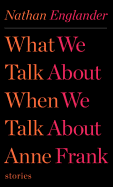
What We Talk About When We Talk About Good Books

Nathan Englander's new book, taking the iconic Raymond Carver story as an exercise in both homage and one-upmanship, debuted yesterday and already the book world is abuzz with it.  It's made all kinds of lists of books to look forward to in 2012 by People Who Matter, and we're happy to let our Odyssey customers out there know that it's really quite excellent and that it lives up to the buzz. Here is just some of the praise he has received for What We Talk About When We Talk About Anne Frank:

"Courageous and provocative. Edgy and timeless. In Englander's hands, storytelling is a transformative act. Put him alongside Singer, Carver, and Munro. Englander is, quite simply, one of the very best we have." --Colum McCann

 "Englander's new collection of stories tells the tangled truth of life in prose that, as ever, surprises the reader with its gnarled beauty . . . Certifiable masterpieces of contemporary short-story art." --Michael Chabon

"A resounding testament to the power of the short story from a master of the form. Englander's latest hooks you with the same irresistible intimacy, immediacy and deliciousness of stumbling in on a heated altercation that is absolutely none of your business; it's what great fiction is all about." --Tea Obreht

Mr. Englander will be doing a reading at the Odyssey on Tuesday, March 6th, at 7:00pm and this new collection of stories is our First Editions Club selection for that month, so come check out the book that Diana, Elli, and Emily are already enthusiastic about. We hope to see you there! Please see our website for full details.

~Emily

Tuesday, November 22, 2011

Book reviews, Good Reads, and Polls: Oh, My!

It's been a quiet blogging month here at the Odyssey.  Not too unusual for November, when the days get shorter, the darkness creeps in a little earlier each night, and our attention gets directed toward the winter holidays. 

It has also been a relatively slow reading month for me, for all of the reasons listed above. (I'm sure it has nothing at all to do with the fact that my last two weekends have been dedicated to watching the BBC show Being Human, courtesy of Netflix streaming.)  But I've done two bookish things in the last few hours that I wanted to share with y'all. 

More recently, I voted in the final rounds of the GoodReads Choice Awards for 2011.  Was I disappointed that The Night Circus didn't make it to the final round for "Favorite Book of 2011?" Sure.  But I was also really, really happy to cast my vote for Deborah Harkness's debut novel, A Discovery of Witches, instead. Deborah, who is an alumna of Mt Holyoke College, launched her book tour with the Odyssey back in February and we knew then that she had a great thing going with her paranormal/historical/bibliocentric novel.

I was awake very early this morning, courtesy of my dog Roxanne who needed to go outside around 5:00 a.m. At first I grumbled about it but then I realized that in fact she gave me the perfect opportunity to finish reading a riveting new book I'd picked up a couple of days ago called Running the Rift. It's Naomi Benaron's Bellwether Prize-winning debut novel, set in Rwanda in the 1990s.  I'd been reading it in 100-page chunks but I didn't want to push through to the end last night when I was so sleepy. 

Well, it was a thoroughly engrossing read.  I'll need to mull it over a bit before posting a full review 'cause right now I'm still reeling from it.  It's one of those books where you know exactly what's going to be happen, even if you don't know the particulars, and the narrative tension builds both from within the story and from without, based on your own knowledge of actual historical events.  Like a novel that opens in Honolulu in 1940, or one that features the Warsaw Ghetto in the late 1930s, you know what you're gonna get with a book featuring Rwanda of the early 1990s. 

All I can say is, read it.  The book releases in January from our good friends at Algonquin and Naomi Benaron will be at the Odyssey on February 2, 2012, for a reading and booksigning, and if you believe in the importance of literature in understanding the human condition and the role it plays in creating empathy & dispelling fear, this is an event you should attend.

~Emily

Sunday, October 23, 2011

Book Review: The Scrapbook of Frankie Pratt


Caroline Preston's  book is a little unusual amidst the world of adult novels--the only reasonable comp I can think of would be the Griffin & Sabine books by Nick Bantock.  It's not quite like the graphic novels we're already familiar with, but it's not entirely dissimilar, either.

It's a gentle book, an old-fashioned book, both in the best senses of the words.  Frankie leaves home in Cornish, NH, in the 1920s and makes her way first to Vassar College, then to NYC and Paris, before she returns home to Cornish.  The text is minimal; instead we get copious amounts of vintage memorabilia and ephemera to illustrate Frankie's journey.

Along the way sheltered Frankie encounters romantic love (doomed and otherwise), privilege, antisemitism, and modernism for the first time in her life, and she's also witness to many important events of the 1920s, such as the publication of Ulysses & The Sun Also Rises, Charles Lindbergh's trans-atlantic flight, and the bohemian expat life of Paris's Left Bank.  (Frankie lives in an apartment above the iconic bookstore, Shakespeare & Co, and I was interested to read that its propietor, Sylvia Beach was the real-life godmother of the author's mother.)

This is an utterly charming adult novel that will have a wide crossover appeal for teen girls. I read an ARC, (advance reading copy) which is reproduced only in black & white, but I know the finished copy will be very pleasing to the eye with its full color spreads.  Adriana Trigiani called this book "a literary bottle rocket--loaded with whimsy, pizzazz, and heart" and I concur.  This book will be published in November by Ecco, and I received a galley of this book from my sales rep, Anne DeCourcey.  I look forward to meeting the author when she's at the Odyssey Bookshop next month! Odyssey favorite author Elinor Lipman, who will be on hand to do the author introduction for us that night, said of this book: "There is magic here and genius. I marveled at every page: at first, just the astonishing collection of souvenirs and memorabilia and then the story—so wry and smart and literary and historically fascinating.”

~Emily