Showing posts with label First Editions Club. Show all posts

Wednesday, March 13, 2013

Book Review: A Tale for the TIme Being by Ruth Ozeki

For my job, I receive books every day with an editor's letter tucked inside, exhorting the 101 reasons why I should read that particular book.  (Why, yes, I do love my job. Thanks for asking.)  But what I do not receive every day is a book with letters from ten different editors around the world, exhorting the 1,001 reasons why I should love this book, and that's the first thing that made me sit up and take notice about Ruth Ozeki's new novel, A Tale for the Time Being. The ARC that Viking sent out included notes from editors in the US, UK, Canada, Spain, Brazil, Germany, Italy, Australia, Greece, and the Netherlands. I had not read Ozeki before, but I thought, "A-ha, clearly this is a book to be reckoned with."

And I was right.  Mostly I just want to heap superlatives on this book, but I'll try to tell you a bit about what the book is about, though that will be tricky.  Like the quantum physics that infuse (infuses? Is the word "physics" singular or plural?) the story, it's a book that alters as one reads and observes. Because a summary would be too complicated, I'm going to borrow the publisher's own marketing blurb here:
In Tokyo, sixteen-year-old Nao has decided there’s only one escape from her aching loneliness and her classmates’ bullying. But before she ends it all, Nao first plans to document the life of her great grandmother, a Buddhist nun who’s lived more than a century. A diary is Nao’s only solace—and will touch lives in ways she can scarcely imagine.
Across the Pacific, we meet Ruth, a novelist living on a remote island who discovers a collection of artifacts washed ashore in a Hello Kitty lunchbox—possibly debris from the devastating 2011 tsunami. As the mystery of its contents unfolds, Ruth is pulled into the past, into Nao’s drama and her unknown fate, and forward into her own future.
Nao has become one of my favorite narrators in literature.  She is very much in the vein of Midori from Haruki Murakami's novel, Norwegian Wood, which is to say she's bubbly, bright, and annoying-but-endearing. Her father is suicidal, and the cruelties she endures at the hands of her classmates (shockingly, with the tacit permission of her teacher) make every American YA novel about bullying look like a bonny good time. It's no wonder that she wants to follow in her father's footsteps and try to end it all.  Yet she has this wonderfully indomitable spirit and sense of humor that juxtaposes in a fascinating way with her avowed fate.

Jiko, Nao's great-grandmother, is also a terrific character. Though there are some secrets she has guarded all of her life, she serves mostly as Nao's sole source of stability and as such, she guides her in the way of  Zen Buddhism. Nothing Nao says or does can offend or surprise her, despite Nao's best efforts.

With the character of Ruth, Ozeki starts to break down fiction's fourth wall. Character Ruth splits her time between New York and an isolated island in the Pacific northwest, just like Author Ruth. Character Ruth is a practicing Buddhist novelist, just like Author Ruth. And the similarities go on.... Ruth (the character) is something of a Japanese scholar trying to defeat a bad case of writer's block, so her obsession with Nao's found diary becomes a way for her to sublimate her anxiety. Her husband is a quantum physics-quoting botanist, so there's that, too.

Top all of that off with the fact that Nao's diary excerpts as they appear in the book are amply footnoted for the benefit of a non-Japanese audience, and that the footnotes are attributed to Ruth--but is it Character Ruth or Author Ruth? It's hard to tell sometimes, and that's the whole point, I think.

I love the opening lines to Nao's first section. They put me a little bit in mind of the Emily Dickinson poem, "I'm Nobody!Who Are You":
My name is Nao, and I am a time being. Do you know what a time being is? Well, if you give me a moment, I will tell you.
A time being is someone who lives in time, and that means you, and me, and every one of us who is, or was, or ever will be. As for me, right now I am sitting in a French maid cafe in Akiba Electricity Town, listening to a sad chanson that is playing sometime in your past, which is also my present, writing this and wondering about you, somewhere in my future. And if you're reading this, then maybe by now you're wondering about me, too (p. 4).
I also love this: "I don't mind thinking of the world without me because I'm unexceptional, but I hate the idea of the world without old Jiko. She's totally unique and special, like the last Galapagos tortoise or some other ancient animal hobbling around on the scorched earth, who is the only one left of its kind. But please don't get me going on the topic of species extinction because it's totally depressing and I'll have to commit suicide right this second" (25).

And this bit about Nao's time living with Jiko at the temple:
They bowed and thanked the toilet and offered a prayer to save all beings. That one is kind of hilarious and goes like this: As I go for a dump/I pray with all beings/that we can remove all filth and destroy/ the poisons of greed, anger, and foolishness.
At first I was like, No way am I saying that, but when you hang out with people who are always being supergrateful and appreciating things and saying thank you, in the end it kind of rubs off, and one day after I'd flushed, I turned to the toilet and said, "Thanks, toilet," and it felt pretty natural. I mean, it's the kind of things that's okay to do if you're in a temple on the side of a mountain, but you'd better not try it in your junior high school washroom, because if your classmates catch you bowing and thanking the toilet they'll try to drown you in it. I explained this to Jiko, and she agreed it wasn't such a good idea, but that it was okay just to feel grateful sometimes, even if you don't say anything (167).
That gives you a pretty good flavor for Nao's narrative sections, equal parts earnestness and impishness. There is so much that is extraordinary about this book, but I fear I'm not doing it justice.  I think I will close with the blurb that I wrote up for Publisher's Weekly Galley Talk, as sometimes it's easier to say more with fewer words:

Zen philosophy and quantum physics blend seamlessly in Ozeki’s brilliant new work of metafiction, where sometimes it’s difficult to distinguish between the author’s attempts to build up and break down the fourth wall. Or as Jiko, the wise and wizened Buddhist nun from the book might say, “to raise or to raze, they are the same.” Jiko’s calm, hard-earned acceptance of contradictions contrasts brilliantly with the life of her great-granddaughter, Nao, a bullied schoolgirl with a suicidal father, adrift in a sea of emotions she is incapable of navigating. When Ruth, on the opposite side of the Pacific, discovers Nao’s diary among the post-tsunami flotsam and jetsam, she becomes obsessed with Jiko’s and Nao’s stories—to the point where she’s convinced that solving the diary’s puzzles will ease her restlessness and dissolve her writer’s block.  I’ve rarely encountered a novel that has made me think about our world quite as much as this one has, where distance and time are mutable depending on the observer, and what is a reader if not the ultimate observer? Ozeki’s novel feels, impossibly, both timeless and utterly of our time, but I suspect that might be the hand of Jiko guiding me. 

Ruth Ozeki will read at Odyssey Bookshop tonight, Wednesday, 13 March 2013, at 7:00 pm. We hope to see you there!  It is also our March selection for our signed First Editions Club.

~Emily

Wednesday, June 13, 2012

Book Review: Beautiful Ruins

I am so excited to tell you about a book that debuted this week!  Jess Walter's new book, Beautiful Ruins,  is well-beloved by many Odyssey staffers, and in fact he will be at the store later this month to do a reading and sign books for our First Editions Club

I read this book so long ago now that I'm not sure I can give it a coherent review, so maybe I'll just say nice things about it instead.  I plucked it from a tall pile of teetering ARCs back in January, when it still felt like winter might be in front of us and I was craving something to take me away.  In those terms, Beautiful Ruins by Jess Walter is much better than Calgon. 

As it turns out, there was no winter in front of us after all, but that doesn't mean I didn't deeply appreciate the sojourns in warm, sunny coastal Italy.  I have to say, I loved this book against all odds: I loathe am not a fan of using multiple narrators to tell a story; it's done entirely too often and rarely done well.  Walter not only uses multiple narrators, he also uses multiple timelines and multiple media in this novel.  We get 1960s Italy, 1980s UK, and contemporary Hollywood; a decrepit hotelier, skeazy film producer,  Hollywood starlet, frustrated assistant, ambitious playwright, and a no-count musician; straightforward third-person narratives interspersed with excerpts from a screenplay (Donner! I kid you not), a rejected memoir, and an autobiographical 3-act play. The catch is that he does it inventively and seamlessly and in a way that evokes a fresh sense of story, and not in a way that is lazy or gimmicky.

Gosh, where do I even begin?  Given all of those disparate elements, it's almost impossible to summarize this novel, and almost as difficult for me to believe that I loved it, but love it I did.  The unlikely pairings of multiple narrative styles with multiple timelines works brilliantly and I salute Walter for it.  I would even go so far as to say that he has set the bar impossibly high for other authors follow. The jacket design is perfect for this book, with the inviting image of a Portofino-like town mingled with a retro-looking typeface.  Once I picked up this book, I could hardly tear myself away from it, so much did I long to immerse myself in this world. I'm almost sad that I've read it already and don't have it to look forward to, because this book would make the perfect summer read.

Here are some of my favorite excerpts:
Weren't movies his generation's faith anyway--its true religion? Wasn't the theater our temple, the one place we enter separately but emerge from two hours later together, with the same experience, same guided emotions, same moral? A million schools taught ten million curricula, a million churches featured ten thousand sects with a billion sermons--but the same movie showed in every mall in the country. And we all saw it...flickering pictures stitched in our minds that replaced our own memories, archetypal stories that became our shared history, that taught us what to expect from life, that defined our values. What was that but religion (21)?
The first impression one gets of Michael Deane is of a man constructed of wax, or perhaps prematurely embalmed. After all these years, it may be impossible to trace the sequence of facials, spa treatments, mud baths, cosmetic procedures, lifts and staples, collagen implants, outpatient touchups, tannings, Botox injections, cyst and growth removals, and stem-cell facial injections that have caused a seventy-two-year old man to have the face of a nine-year-old Filipino girl (93).
But aren't all great quests folly? El Dorado and the Fountain of Youth and the search for intelligent life in the cosmos--we know what's out there. It's what isn't that truly compels us. Technology may have shrunk the epic journey to a couple of short card rides and regional jet lags--four states and twelve-hundred miles traversed in an afternoon--but true quests aren't measured in time or distance anyway, so much as in hope. There are only two good outcomes for a quest like this, the hope of the serendipitous savant--sail for Asia and stumble on America--and the hope of scarecrows and tin men: that you find out you had the thing you sought all along (284).
So if you're looking for a fantastically-good summer read that will whisk you away from your daily grind, or if you're interested in the structure of fiction and how authors play around with it, do yourself a favor and check out Beautiful Ruins.   The author, whom I got to meet in Boston a couple of months ago at a Harper dinner, is also a real sweetheart of a fella.  Thank goodness I met him then because I'll miss his reading later this month when I'm away on vacation.  But trust me on this one--this is a book you're going to want to read, written by an author you're going to want to meet.

~Emily

Friday, May 11, 2012

Book Review: Billy Lynn's Long Halftime Walk

Book Summary: Told over the course of a single day--specifically Thanksgiving Day at Texas Stadium, as the Dallas Cowboys take the field--Billy Lynn's Long Halftime Walk is the story of Bravo Squad, eight survivors of a ferocious firefight with Iraqi insurgents, whose bravery and and valor have made them national heroes. In the final hours of their Pentagon-sponsored "Victory Tour," Bravo's Silver Star-winning hero, nineteen-year-old Billy Lynn, will confront hard truths about love and death, family and friendship, war and politics, duty and honor.

This is one of the best books I've read all year, and one that I'd say is a real contender for 2013's round of major literary awards. The writing is terrific, and I feel that in addition to being a fresh and edgy book, this may be an important one. So far it's the only one I've read coming out of the Iraq War that subsumes itself in neither action sequences nor in an overwrought family or romantic drama. Instead it seems to be just as much about the concept of war itself as the politics behind it and how America feels about it. (Though given the book takes place mostly in Texas, especially Dallas, we're not really given a look at the dissenters' side of things.) 

Billy Lynn is a fascinating character, a boy thrust into the army (in lieu of doing hard time) after taking a crowbar to his sister's ex-fiance's car for gallant but misguided reasons. He's a thoughtful young man, fully aware that the labels of "hero" mean nothing when one's actions are guided neither by bravery nor fear, but are simply reactionary to any given situation, including Bravo's famous firefight with the Iraqi insurgents: one day you're the hero and the next day you're cowering under your humvee and refusing to come out. His thoughts are never far away from his imminent return to Iraq, nor from his buddy, Shroom, who died the day Billy was labeled a hero.

Ben Fountain's novel is also the first book coming out of the Iraq War (that I've read, at least) that seems willing to say that war is, more than anything else, a commercial enterprise. It's difficult not to draw these parallels about the US's involvement in Iraq with, say, the Dallas Cowboys franchise and the oil-steeped politics of the state in which the book is largely set, or the larger-than-life characters we meet, such as the Dallas Cowboys' owner or the man who spends the book negotiating a movie deal for Bravo. War as commercially motivated enterprise, not a political one, isn't a new concept per se, but it goes a long way in increasing this particular reader's distaste for it, because if it's really not about oil, really not about protecting our interests, and really not about freeing a people from their dictator's rule, then it's really not something I can ever understand, or wish to, for that matter. What's more, Fountain seems to be suggesting that, despite whether they're for or against the Iraq War, that most Americans only monitor it from the comfort of their living sofas, and thus we have an enterprise reduced to entertainment television.

Karl Marlantes blurbs this book, and he's not a writer whose opinion I take lightly, especially when it comes to the topic of war. He calls it "the Catch-22 of the Iraq war," and with a comment like that, I'm not sure that there's anything more to add.  I'll just conclude with some passages that resonated with me as I read it:

"So they lost Shroom and Lake, only two a numbers man might say, but given that each Bravo has missed death by a margin of inches, the casualty rate could just as easily be 100 percent. The freaking randomness is what wears on you, the difference between life, death, and the horrible injury sometimes as slight as stooping to tie your bootlace on the way to chow, choosing the third shitter in line instead of the fourth, turning your head to the left instead of the right. Random. How that shit does work on your mind (26-27)."

"Those people [movie studios, producers, etc], the kind of bubble they live in? It's a major tragedy in their lives if their Asian manicurist takes the day off. For those people to be passing judgment on the validity of your experience is just wrong, it goes beyond wrong, it's ethics porn. They aren't capable of fathoming what you guys did (57)."

I love this moment between Billy and his sister Kathryn, re: their father:
" 'He's an asshole,' Kathryn said. 
To which Billy: 'You just now figured that out?' 
'Shut up. What I mean is he likes being an asshole, he enjoys it. Some people you get the feeling that can't help it? But he works at it. He's what you'd call a proactive asshole' (75)."

Billy with his nephew on leave:
"Based on his highly limited experience with small children, Billy had always regarded the pre-K set as creatures on the level of not-very-interesting pets, thus he was unprepared for the phenomenal variety of his little nephew's play. Whatever came to hand, the kid devised some form of interaction with it. Flowers, pet and sniff. Dirt, dig. Cyclone fence, rattle and climb. Squirrels, harass with feebly launched sticks. 'Why?' he kept asking in his sweetly belling voice, as pure as marbles swirled around a crystal pail. Why? Why? Why? And Billy answering every question to the best of his ability, as if anything less would disrespect the deep and maybe even divine force that drove his little nephew toward universal knowledge...So is this what they mean by the sanctity of life? A soft groan escaped Billy when he thought about that, the war revealed in this fresh and grusome light. Oh. Ugh. Divine spark, image of God, suffer the little children and all that--there's real power when words attach to actual things. Made him want to sit right down and weep, as powerful as that. He got it, yes he did, and when he came home for good he'd have to meditate on this, but for now it was best to compartmentalize, as they said, or even better not to mentalize at all (82-83)."

The reader never gets the full picture of exactly what happens to earn the Bravo Squad their Victory Tour back home, but here is one of Billy's ruminations on it: "All your soldier life you dream of such a moment and every Joe with a weapon got a piece of it, a perfect storm of massing fire and how those beebs blew apart, hair, teeth, eyes, hands, tender melon heads, exploding soup-stews of shattered chests, sights not to be believed and never forgotten and your mind simply will not leave it alone. Oh my people. Mercy was not a selection, period. Only later did the concept of mercy even occur to Billy, and then only in the context of its absence in that place, a foreclosing of options that reached so far back in history that quite possibly mercy had not been an option there since before all those on the battlefield were born (125)."

Read this book.  Seriously, just read it. And if you don't want to take my word for it, check out this superlative review from The New York Times earlier this week.

Billy Lynn's Long Halftime Walk is the Odyssey Bookshop's May selection for its First Editions Club. Ben Fountain will be reading at the store tonight, May 11, at 7:00 pm. 

~Emily

Wednesday, February 8, 2012

What We Talk About When We Talk About Good Books

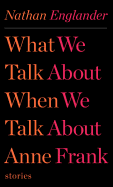
Nathan Englander's new book, taking the iconic Raymond Carver story as an exercise in both homage and one-upmanship, debuted yesterday and already the book world is abuzz with it.  It's made all kinds of lists of books to look forward to in 2012 by People Who Matter, and we're happy to let our Odyssey customers out there know that it's really quite excellent and that it lives up to the buzz. Here is just some of the praise he has received for What We Talk About When We Talk About Anne Frank:

"Courageous and provocative. Edgy and timeless. In Englander's hands, storytelling is a transformative act. Put him alongside Singer, Carver, and Munro. Englander is, quite simply, one of the very best we have." --Colum McCann

 "Englander's new collection of stories tells the tangled truth of life in prose that, as ever, surprises the reader with its gnarled beauty . . . Certifiable masterpieces of contemporary short-story art." --Michael Chabon

"A resounding testament to the power of the short story from a master of the form. Englander's latest hooks you with the same irresistible intimacy, immediacy and deliciousness of stumbling in on a heated altercation that is absolutely none of your business; it's what great fiction is all about." --Tea Obreht

Mr. Englander will be doing a reading at the Odyssey on Tuesday, March 6th, at 7:00pm and this new collection of stories is our First Editions Club selection for that month, so come check out the book that Diana, Elli, and Emily are already enthusiastic about. We hope to see you there! Please see our website for full details.

~Emily