Thursday, February 9, 2012

They Don't Get Better Than This: The Fault in Our Stars

I met John Green a couple of weeks ago when he was participating on a panel for Winter Institute and was one of the big draws at the author receptions.  Up until then, I had only read Will Grayson, Will Grayson, a book that he cowrote with David Levithan, and while I knew he was a beloved author, I really had no clear idea why until that time in New Orleans.  On his panel he kept talking about his horrifically tragic books, but he himself was so damn funny (and WG, WG tipped decidedly toward the funny end of the scale, not the tragic one) that it was difficult for me to feature.

I left work on Thursday with a signed copy of The Fault in Our Stars tucked under my arm, winging a comment back to my colleague Marika as I left that I was looking forward to the emotional ride. Little did I know! I was barely into Chapter One before the bed was shaking with laughter and my husband sniffed at me from over the top of his own, decidedly-less-funny book,  The Crossing by Cormac McCarthy. My cats didn't seem to mind, though my sweet Murray did start licking my face when the laughter abruptly shifted to tears. I'm telling you, this book chewed up my heart and spit it back out again, but I had an absolutely Grand Time for the duration.

You know the movie Steel Magnolias?  I love that movie, not least for its eminent quotability, and one of the first lines I committed to memory was one of Dolly Parton's: "Laughter through tears is my favorite emotion." Well, this book is the pure-dee embodiment of that sentiment.  There were times my shoulders were a-shakin' and I'd be very hard-pressed to determine if it were more from the tears or more from the laughter, for I could suppress neither for very long.

Probably most of you who are reading this review know exactly what this book is about, but for my mom and my husband, and those of you who don't, perhaps, have your fingers on the pulse of YA publishing, here's a short summary: two teenagers meet and fall in love.  So far, so good.  But it's where they meet that shapes this book's content--at a support group for teens with cancer. The reader absolutely knows from the beginning that the book cannot end well, but that doesn't keep the reader from hanging herself with the hope rope. (Or maybe that's just me.) Augustus and Hazel wouldn't be your typical teens even without their missing or weakened body parts.  They're smart, curious, snarky, and introspective. Their cancer has taken them beyond politeness to that realm where fools are not suffered gladly and where the concept of pussyfooting around topics other (read: normal) people find uncomfortable is unfathomable.

The dialogue is exactly what dialogue should be in real life, if only we got to rehearse and make it perfect yet authentic. The pathos in the book is a fitting tribute to the title's source: nothing less venerably tragic than Shakespeare's Julius Caesar ("The fault, dear Brutus, is not in our stars,/ But in ourselves").

There's book talk, video games, a friend who goes blind, some mild vandalism, a trip to Amsterdam, Two Very Important Venn diagrams, and an asshole of an author, and throughout it all the book boils down to narrative perfection. My two main critiques of the book have nothing to do with the content and everything to do with design: 1) the cover design is not very good, and in fact it's hard to read the text underneath the white cloud, and (2) The lovely-to-look-at typeface which is also, in fact, easy to read, is never identified.

Really, I cannot recommend this book enough.  Just read it, y'all!

~Emily

Wednesday, February 8, 2012

What We Talk About When We Talk About Good Books

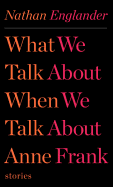
Nathan Englander's new book, taking the iconic Raymond Carver story as an exercise in both homage and one-upmanship, debuted yesterday and already the book world is abuzz with it.  It's made all kinds of lists of books to look forward to in 2012 by People Who Matter, and we're happy to let our Odyssey customers out there know that it's really quite excellent and that it lives up to the buzz. Here is just some of the praise he has received for What We Talk About When We Talk About Anne Frank:

"Courageous and provocative. Edgy and timeless. In Englander's hands, storytelling is a transformative act. Put him alongside Singer, Carver, and Munro. Englander is, quite simply, one of the very best we have." --Colum McCann

 "Englander's new collection of stories tells the tangled truth of life in prose that, as ever, surprises the reader with its gnarled beauty . . . Certifiable masterpieces of contemporary short-story art." --Michael Chabon

"A resounding testament to the power of the short story from a master of the form. Englander's latest hooks you with the same irresistible intimacy, immediacy and deliciousness of stumbling in on a heated altercation that is absolutely none of your business; it's what great fiction is all about." --Tea Obreht

Mr. Englander will be doing a reading at the Odyssey on Tuesday, March 6th, at 7:00pm and this new collection of stories is our First Editions Club selection for that month, so come check out the book that Diana, Elli, and Emily are already enthusiastic about. We hope to see you there! Please see our website for full details.

~Emily

Tuesday, February 7, 2012

The Many Covers of A Wrinkle in Time

You may have heard that this year is the 50th Anniversary of Madeleine L'Engle's science-fiction classic A Wrinkle in Time.  L'Engle received tons of rejection letters for her book which many editors thought was not a children's book.  However, since publication, it has won the Newbery and had handfuls of different covers.  Rebecca Stead's 2009 Newbery Award-winning book When You Reach Me is even an homage to L'Engle's classic.  My mother's bookshelf has three copies of this book- each with a different cover.   Check out the covers below...which did you grow up with and which are your favorites?

 This is the original cover.  If you take off the dust jacket of the hardcover 50th Anniversary edition, this is the cover you'll find underneath. 
 The most recent paperback cover.  The entire series was released with covers by the same illustrator, and they're all wonderful.  I love the texture of the prints. 

 A pulpy, sci-fi classic sort of cover.  I know my mom has one of these. 

 A cover by Peter Sis.  I think it captures a surrealistic quality in the book. 

 This cover has the feel of a classic fantasy novel . 

 A cover by Leo and Diane Dillon.  I love all their work and have the set with their covers.  I think this cover works well for both adults and children. 

 A more realistic, classically children's, cover.  My mom has a copy with this cover, but it's never been a favorite of mine. 
 I'd never seen this cover until today, and I think it paints a very happy, idealistic image at odds with what's actually inside. 
 Also a cover I'd never seen before. 
And, finally, the dust jacket for the 50th Anniversary edition.  The rings are highlighted with gold and the type is raised.  I love this cover and the original (printed on the boards beneath the dust jacket). 

What do you think?  Which covers are your favorites? 

-Marika

Monday, February 6, 2012

We Are All Korean: A (borrowed) Guest Blog Post by Adam Johnson

If you've  been in the bookstore over the weekend, you probably noticed large carts full of one particular book, The Orphan Master's Son by Adam Johnson, which is the Odyssey's First Editions Club selection.  We weren't quite able to get Adam to the store for a reading, much to our disappointment, but our heroic sales rep, Michael Kindness, was able to figure out a way for us to take books to the author instead.  Yay--we have signed first printings for sale now!

I met Adam at Winter Institute in New Orleans a few weeks ago and have been following media on his book since its publication in mid-January (it's *amazing* and one of those books that really stays with you).  I was delighted to see the following guest blog post at Lemuria Bookstore's blog that Adam wrote for his author appearance at that fine store, so I asked the good folks at Lemuria if we might be able to use his guest post, too.  With Lemuria's and Adam's blessing, here it is:


"We are all Korean”
Upon arriving in Pyongyang, one of our first stops was the National Museum of Korean History. It was a large museum with no one in it. To save electricity, which was quite scarce, the museum used motion sensors that turned out the lights when you left a room and flashed them on when you entered the next, so the cavernous journey was taken one flashing glimpse at a time. The first exhibit they showed me was what they claimed was an old skull fragment. It was displayed in a Plexiglas box atop a white pedestal. They informed me that the skull was 4.5 million years old and that it had been found on the shores of the Taedong River in Pyongyang. I was new to such tours, so my brain was filled with dissonance. I asked the museum docent, a middle-aged woman wearing a beautiful choson-ot, if humanity didn’t originate in Africa. “Pyongyang,” she said. I’d taken a course on human origins when I was an undergraduate, and a hazy memory came to me. I said, “So is this a skull fragment from an australopithecine?” She said, “No, Korean.” And I understood that she was a person trained to give a tour and recite prescribed information, not a scholar or curator. In North Korea, whenever evidence is lacking for something, they use a big painting or an elaborate diorama as proof. They had both on hand to explain via arrows and diagrams, how humanity had originated in Pyongyang, with the following Diaspora moving north into Asia and west into the Middle East and Europe. Finally, according to the diorama, humans populated Africa and North America. We had several minders with us, all watching my response to this new information. Finally, our tour guide concluded her lecture by informing me that the World was Korean (by which she meant North Korean) and by informing me that I was actually Korean. A friend of mine, a fellow professor on the tour with me, turned to me and said, “Did you hear, Professor Johnson? You are Korean. Do you feel suddenly Korean?”
I pat my arms and sides. “Yes,” I said, “I feel a little more Korean.”
He said, “You look a little more Korean.”
I rubbed my cheek and chin. “Yes,” I said, “I believe I’m a little more Korean.”
Our tour guide and minders all nodded, with some gravity, at my dawning realization.
So the lesson I learned in the National Museum of Korean History was that there was no irony in the Democratic People’s Republic of Korea.
*      *     *
Adam Johnson is Associate Professor of English with emphasis in creative writing at Stanford University. A Whiting Writers’ Award winner, his fiction has appeared in Esquire, Harper’s, Playboy, Paris Review, Tin House and Best American Short Stories. He is the author of Emporium, a short-story collection, and the novel Parasites Like Us, which won a California Book Award. 


~Emily Crowe

Saturday, January 21, 2012

Situations Matter

A few months ago I had picked up an advance reader's copy of Situations Matter by Sam Sommers, meant to write a blog post about it and then got entirely too busy. Now that it's been published and is in the store, I've remembered how long I've been meaning to write about it and made some time to finally get it done.

The author, Sam Sommers, is a psychology professor at Tufts who specializes in examining how situations change us and our decision making. He argues that many of our assumptions about human nature are wrong, and can be explained by a closer look at the situations around various actions. Whether we're aware of it or not, all sorts of things can change how we act, from standing in a crowd to being the only person of your ethnic background in the room.

The chapter examining our assumptions about innate gender differences is fascinating, especially when he takes on the controversial statements made by former Harvard president Larry Summers on math and science ability in women. The way researchers have been able to erase or exacerbate the "gender gap" in math just by changing the circumstances of the test made sure I will never look at claims of innate ability in any subject the same way again.

I think this book does a great job of explaining the power of context, which goes a long way to assist us in our understanding of ourselves and others. While not a self-help book, there are many things in this book that can help you use knowledge of situations for your own benefit. For example, I'm in a band that plays at various places throughout Western and Central Massachusetts, and some crowds just aren't into the music as much as they are their beverages. After reading about the man who makes a living pretending to be a normal fan cheering like crazy at sporting events, I make sure to have a few friends in the audience that will dance, sing along, and help get the party going. The tip jar definitely shows the difference!


Monday, January 16, 2012

Dreaming of a Better World

I thought that on Martin Luther King, Jr. Day it was appropriate for me to blog about one of the most exciting books I've read recently, Dream of a Nation: Inspiring Ideas for a Better America. This book is a collection of writings by a whole lot of people who have done some amazing things, and have great ideas on how to improve the world we all live in. (Full disclosure time: I also work at National Priorities Project. NPP was founded by Greg Speeter, who wrote one of the chapters, so I am 1/62nd biased. I won't review his chapter but I will say I think it's great!)

I think it's pretty safe to say that most people have concerns about the way we are living. If you've ever found yourself wondering if living in a democracy should be about more than voting and shopping, or what can be done to make sure all children get equal educational opportunities, read this book. The chapters cover such a wide range of topics that everyone is sure to find something they are passionate within these pages. The best feature of this book is that almost all of the chapters not only inform about widespread problems, but offer suggestions of things all of us can do about them.

Some of these tips can have staggering benefits. For example, switching just the five most used lightbulbs in your home with compact fluorescent bulbs can save you about $90 a year, and 662 pounds of coal worth of energy. Changing to independent news sources may not have that same quantifiable dollar figure, but will certainly help you get a different perspective on the world. I thought that "Key Steps for a Healthy Nation" was one of the most memorable segments of the book, with the statistic that 40% of premature deaths in the United States are due to personal behavior patterns. However, on the very next page it details the four healthy habits that can cut risk of diabetes by 93%, heart attack by 81%, and stroke by 50%.

While you could sit down and read it in one go, I think it's set up perfectly to keep handy for reading in small increments over a long period of time. Keep this book on hand for all those nights where you've got 15 minutes before dinner comes out of the oven. Instead of checking your email or Facebook again, flip to a new chapter and get ready to be inspired! 

When I saw this book for the first time, it reminded me of one of favorite textbooks from college, which was a collection of essays about environmental issues. However, the interior could not be more different. Instead of a bunch of essays with the occasional black and white chart of rising temperatures, this book is colorful, appealing, and beautifully designed from cover to cover. I've had a great time reading this book, and I hope you enjoy it too! -Sheila

Monday, January 2, 2012

2012 Resolution... To be and stay informed!

If your new year's resolution is to be more informed in 2012 then you are in luck because at the Odyssey we can help you out with that! 
I've become lax in my keeping up with current events since my college extemporaneous speaking days. And while I do read several online newspapers in an attempt to stay abreast of what is going on in the world, books are always better at giving one an in depth understanding of news trends.


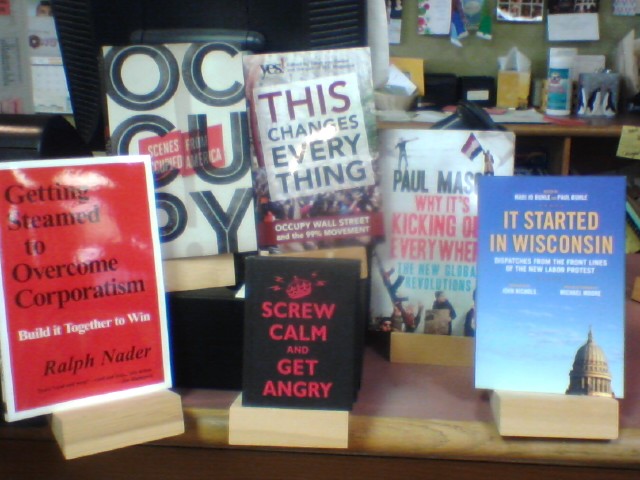
Currently we have several books (on display on the first floor counter) covering the Occupy and protest outlash phenomena that dominated news coverage and will, arguably, continue to do so. 

Here are a couple of books on my reading list and some publisher excerpts explaining why you might want to put them on yours too: 

 
From the publisher's descprition: 
In the spring of 2011, Wisconsinites took to the streets in what became the largest and liveliest labor demonstrations in modern American history. Protesters in the Middle East sent greetings and pizzas to the thousands occupying the Capitol building in Madison, and 150,000 demonstrators converged on the city. In a year that has seen a revival of protest in America, here is a riveting account of the first great wave of grassroots resistance to the corporate restructuring of the Great Recession. 


 From the publisher's descprition: 
We Are the 99%. The Occupy Wall Street movement named the core issue of our time: the overwhelming power of Wall Street and large corporations-- something the political establishment and most media have long ignored. But the movement goes far beyond this critique. "This Changes Everything" shows how the movement is shifting the way people view themselves and the world, the kind of society they believe is possible, and their own involvement in creating a society that works for the 99% rather than just the 1%.


From the publisher's descprition: 
The world is facing a wave of uprisings, protests and revolutions: Arab dictators swept away, public spaces occupied, slum-dwellers in revolt, cyberspace buzzing with utopian dreams. Events we were told were consigned to history democratic revolt and social revolution are being lived by millions of people. In this compelling new book, Paul Mason explores the causes and consequences of this great unrest. From Cairo to Athens, Wall Street and Westminster to Manila, Mason goes in search of the changes in society, technology and human behavior that have propelled a generation onto the streets in search of social justice. 


From the publisher's descprition: 
In the fall of 2011, a small protest camp in downtown Manhattan exploded into a global uprising, sparked in part by the violent overreactions of the police. An unofficial record of this movement, Occupy! combines adrenalin-fueled first-hand accounts of the early days and weeks of Occupy Wall Street with contentious debates and thoughtful reflections, featuring the editors and writers of the celebrated n+1, as well as some of the world s leading radical thinkers, such as Slavoj i ek, Angela Davis, and Rebecca Solnit. The book conveys the intense excitement of those present at the birth of a counterculture, while providing the movement with a serious platform for debating goals, demands, and tactics. 


What do you think? 


Paz,


Nieves