Tuesday, August 9, 2011

Terrific Tuesday Book Release: The Family Fang by Kevin Wilson

The Family Fang by Kevin Wilson
Meet Caleb & Camille Fang and their children Annie and Buster, known at home and at large as Child A and Child B.  They’re a family dedicated to making art, but not in a way that anybody would expect.  The term performance art doesn’t quite do justice to what they do—it’s more like guerilla warfare aimed at a complacent public, and it’s not “good” in their eyes unless somebody ends up bleeding, broken, arrested, or worse.  This book is laugh-out-loud on the surface, but the absurdity really only masks a darker level where children are valued only as much as the next prop and where the parents’ final performance is both devastating and liberating.  This book is a marvelous find.  

This book releases in hardcover today, but my Harper rep, the amazing Anne DeCourcey, handed me an ARC of this book  several months ago and told me that I should read it.  She was right, as she so often is.  Here are some of the passages that resonated with me--either because of the writing, the humor, or my own self-identification.  

On why there should be a third film in The Powers That Be franchise, in which Annie starred: "Yes, well, I think we can all agree that everyone loves watching Nazis getting hit with lightning bolts."  Later on that page, Wilson describes a sip of gin: "So clean and medicinal it felt not unlike surgery under light anesthetic."  My husband, a gin drinker of the highest order, couldn't agree more.  

On how simultaneously funny and pathetic Buster is, upon the prospect of sex: "He could count on one hand the number of times he'd had sex and still have enough fingers left over to make complicated shadow puppets."

Buster again, after his sister has left home and he's alone with his parents, not knowing how to be around them without her: "His mother and father were laughing with such vigor, so genuinely moved, that Buster tried it out, to see what it felt like.  He laughed and laughed and, though he did not yet know what the joke was, he hoped it would be worth the effort he'd already put into enjoying it."

These people are profoundly f*cked up.  And profoundly funny.  And profoundly disturbing.  Just read it. Seriously.  

If you read book blogs at all, you know that this book has been getting some major buzz in the blogosphere for the last few months.  This is the book that will put Kevin Wilson on the literary map, and if you are hangin' around in western Massachusetts next Saturday afternoon, August 20, please stop by the bookstore to hear him read from The Family Fang.  Beloved author Ann Patchett personally assured me that Mr. Wilson is one of the best writers we have in the US today and is one of the best guys ever, full stop.  So stop by the store and meet him in person!


~Emily Crowe

Wednesday, August 3, 2011

New in paperback fiction: travel to Engand and Nigeria without leaving home!

Summer is a great time to get caught up on your reading, and there are two books recently out in paperback that I raved about when they were first published.  Each one is perfect for summer vacation reading, because even if you're not getting away someplace, these books will transport you. 

The Distant Hours by Kate Morton.  This lush novel interweaves three separate stories that span the 20th century.  All of the factors for a great English mood novel are present: a castle, a family whose creative streak is matched only by its madness, three spinster sisters, a quaint village, mysterious disappearances, ancient secrets, and a young publisher trying to sort fact from fiction in the local lore.  The stories meander at a deliberate pace, all converging in the last chapter in a most satisfying way.  This book is perfect for those readers who want to really sink their teeth into an atmospheric novel that will make them want to curl up for hours with a pot o' tea. 

The Secret Lives of the Four Wives by Lola Shoneyin.  You'd think that a book set in Nigeria about a polygamist and his four wives would feel exotic and exude a sense of "otherness," but this first novel feels so familiar that the characters might be people you know.  When Baba Segi takes on his fourth wife, a well-educated young woman trying to escape her past, his first three (jealous) wives spare no act of deceit or vindictiveness to rid the compound of the new interloper.  But will their efforts to keep a dark secret hidden result in tragedy for them all?  A terrific first novel!

Wednesday, July 20, 2011

Short Story Perfection: A Review of Eric-Emmanuel Schmitt

There is one word that comes to mind when I think of Eric-Emmanuel Scmitt's new collection of short stories, Concerto to the Memory of an Angel--and I should stress that it is not a word that I commonly use when writing book reviews--and that word is "perfect." In the US, the short story seems to get short shrift and I'm not sure why.  Of the various literary forms, I consider it to be among those most difficult to execute well. Great novels are a dime a dozen, but not so the great short story collection.  They are far less common and thus all the more to be valued when I do come across one.  This work has achieved a perfect and rare balance.  To add or to take away anything would ruin it.  I could continue to heap superlatives on it, but I'm fairly sure that, in my native tongue at least, "perfect" is pretty much the highest praise.  

This is Schmitt's third collection to be translated into English from his original French, brought to American audiences courtesy of Europa Editions and Alison Anderson's fine translation (which surely adds much to the book's perfection).  Full of philosophy and quiet moments of ephiphany, these stories range from a father's intensely private ruminations on the death of a child to a portrait of a celebrity marriage very much in the public eye.  Each story leaves the reader a little bit slack-jawed with amazement that so much can be conveyed and accomplished with such efficiency.  If you value fine writing and the remarkable execution of a difficult craft, this is a book you should purchase for your collection right away.

The only negative point I can think to raise is that despite Europa's very high production qualities overall, Scmitt's works suffer from dreadful jacket design and a tendency toward awkward book titles. 


~Emily Crowe

Monday, July 18, 2011

Three Novels: Women and War

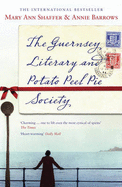
I don't read many war novels, per se, with all of their action and violence and killing, though Andrew Krivak's excellent novel, The Sojourn, is a recent exception to that rule. No, I prefer to know the stories of the people who get left behind, or who are outside the immediate threat of battle.  This means largely, but not always, the story of women and war.  In the last couple of weeks I have read two novels about women during World War II, and each in its way reminded me of a book from a few years ago, which I loved--The Guernsey Literary and Potato Peel Pie Society.  If any of you dear readers loved Guernsey like I did, I think you might find something of interest in these other two.  If you are not familiar with it,  this epistolary novel, set just after World War II in London and the isle of Guernsey, is sweet, charming, and old-fashioned, in all the best senses of the words.  Juliet Ashton is a journalist who begins a correspondence with the residents of Guernsey, and through their letters we get a remarkable portrait of a community's strength and perseverance during the Nazi occupation.  It is a slender tome, full of both laughter and heartwarming moments,  and overflowing with characters you'll wish you could call friends.

Sarah Blake's The Postmistress straddles two worlds: pre-war America and London during the blitz. When Emma's husband, a small town doctor in Cape Cod, MA, blames himself for a patient's death, she finds herself abandoned when he volunteers to work in a London hospital to make karmic amends.  Iris is the titular postmistress in the same small town, who takes her official job as postmaster as seriously as her unofficial job of keeping her small community informed (or not) of the goings-on in the world.  An ocean and a world apart, Frankie works for the BBC, desperately trying to tell her nightly stories in a way that will make the war seem real to her fellow Americans--real enough to sit up and participate, rather than dismiss it as something unfortunate that happens to other people. All three women cross paths after Frankie witnesses something in London and feels compelled to travel back to the US to find Emma and to confront Iris.

In the meantime, Blake does a great job of establishing how life must go on, whether you're waiting every single day for months to hear from your husband to know whether he is alive, or whether your home has been bombed and you have no place left to live.  Most of all, though, she shows the importance of telling stories and bearing witness--that in the end, it's only our personal connections with other humans that will get us involved, either literally or metaphorically, in a way that will effect  a change in this world.

Margaret Leroy's The Soldier's Wife takes place during the Nazi occupation of the island of Guernsey during WWII, and its third person narrative follows Vivienne de la Mare, a woman who must daily walk the fine edge between patriotism and practicality.  After her husband enlists, it falls to her to keep her daughters and her ailing mother-in-law safe in a world that has suddenly become alien to her. When German officers requisition the house next door and turn out to be rather neighborly, Vivienne finds herself constantly second-guessing her actions under their scrutiny.  Other islanders may be high-minded about fraternization, but Vivienne simply cannot afford those same scruples when her family's well-being is at stake.  Only when food from their their own scarce supply goes missing and her younger daughter regales her nightly with tales of the ghost in the barn does Vivienne realize that there is a moral burden unfolding that might become too heavy for her to bear.

What I really liked about The Soldier's Wife is that unlike many wartime settings, it leaves room for people who are neither cowardly nor heroic, but somewhere in between.  At first I was a little surprised about the rapport Vivienne develops with some of the German officers, but I think it is perhaps a more realistic presentation than the patriotic resistance narrated in The Guernsey Literary & Potato Peel Pie Society.  It demands that readers reflect on what they would or would not do to preserve their family: Would you feed another starving human if it means your children will go without food? Would you risk your home as a safe house? Would you turn away from the torture or murder of a prisoner when interfering means deportment to a work camp? How do you raise your child to be a moral person when you cannot the example you want to, because to do so is to risk your life or your child's?

And there's always the smaller, garden variety dilemma.  If the kind German officer across the street gives you medicine to save your daughter, are you morally required to show him gratitude when it's the German occupation that is causing the dire shortage of needful things? If so, how much gratitude?  If medicine is okay to accept, what about a loaf of bread? Clothing? More than anything else, I would say that this book demonstrates that for most of us who aren't cut out to play the noble hero, the lines we draw in the sand between what we are and are not capable of doing are ever-shifting under the weight of our complicated humanity.

~Emily Crowe

Monday, July 11, 2011

Who's Afraid of The Last Werewolf?

The Last Werewolf by Glen Duncan
I feel I should start by saying that this book is a departure from my usual reading.  But then again, I've been saying that rather frequently lately, so maybe I need to re-evaluate what constitutes my "usual reading."  Really, though, I normally wouldn't pick up most books with the word werewolf in the title, but most werewolf books aren't published by Knopf, the most literary imprint of all of Random House's imprints, and most of them aren't chock full of human insight and literary allusion.

Jacob Marlowe is the last surviving werewolf on record, helped along by his covert human familiar, Harley. When the book opens, it's not likely that Jake will survive another moon cycle, as Grainer, a special-ops werewolf hunter, has vowed to track him and take him down, eliminating the last of his kind from the face of the earth.  However, a wealthy socialite with dark appetites and an elite cabal of vampires have other plans; they want to abduct him and conduct experiments on him with the hope of curing their daytime curse.  If this sounds like it's treading the same old werewolf/vampire/special ops territory, however, you couldn't be more wrong.  The intelligent prose and Jake's existential philosophies make this a very smart book, indeed.  It's fast-paced, sexy, graphic, and it will be the ruler against which all future werewolf books will be measured -- and found wanting.  With no offense meant toward genre fiction, this is a novel that transcends its genre in a luminescent way.  And which will completely redefine what it means to be "Team Jacob."

I dog-eared dozens of pages and noted twice again that many passages, some of which I've included here:

"I lifted her hair out of the way and worked her trapezius from scapula to occipital bone.  Anatomical Latin's an unjudgemental friend if you have to rip people apart and eat them."

"One develops an instinct for letting silence do the heavy lifting.  In the three, four, five seconds that passed without either of us speaking, the many ways the conversation could go came and went  like time-lapse film of flowers blooming and dying."

"We were in bed, her lying with her wrists crossed above her head, me up on one elbow, caressing her nakedness.  The flesh had infinity in it.  I must have known every inch by touch, yet every inch renewed its mystery the instant my hand moved on.  Delightful, endless futility."

"The point is I make no apology and ask no forgiveness. I'm a man. I'm a monster. A cocktail of contraries. I didn't ask to become a werewolf but once it had happened I got used to it pretty quickly. You surprise yourself. You surprise yourself, then realise even the surprise was a bit of a sham."

"I changed channels.  American Idol. Transformation again, this time from Nobody into Superstar. Perhaps Jacqueline was right: humanity's getting its metamorphic kicks elsewhere these days. When you can watch the alchemy that turns morons into millionaires and gimps into global icons, where's the thrill in men who turn into wolves?"

"Filial honour. Forty years ago I killed and ate Grainer's father.  Grainer was ten at the time.  There's always someone's father, someone's mother, someone's wife, someone's son. This is the problem with killing and eating people.  One of the problems."

Did I mention that the author is dead sexy?

The Odyssey Bookshop also is lucky enough to have a limited number of signed first printings of The Last Werewolf--Knopf did a beautiful job, with the top, bottom, and fore-edges are all stained a deep maroon and the phases of the moon on the front cover in a lovely, iridescent gold--so call us or drop by to reserve your copy while they last!

Thursday, July 7, 2011

Book Review: Turn of Mind by Alice LaPLante

Turn of Mind, a debut novel from author Alice LaPlante, is not your ordinary literary mystery.  Jennifer White is a retired surgeon suffering from dementia, who also happens to be the chief suspect in the murder (and minor mutilation) of her best friend and neighbor, Amanda.  But how on earth can this crime be solved when the prime suspect cannot even remember her own children from day to day?  Or when Jennifer is brokenhearted anew to learn of Amanda's death each time the detective comes by to speak with her?  Jennifer's mind has good days and bad days, sometimes good hours and bad hours within the same day, and for the longest time it seems as if the mystery will go wholly unsolved, with Jennifer herself unsure of what happened on the day her friend was last seen alive.

This book is an extraordinary and gripping look into a once-sharp mind as it descends towards the terrifying alienation and the inaccessible abyss of memory that circumscribe dementia. Avowed mystery readers may see the end coming, but I myself did not.  Despite the mutilation (Amanda's body is found with a few fingers severed, post mortem), this is not a gory or graphic book at all, and I would recommend this book to anyone looking for a good mystery or a good book about a complicated, brilliant, but not always likable woman who somehow is able to keep her head even while she loses her mind.

This book is published by Atlantic Monthly and it happens to be the #1 pick for the month of July, voted on by Indie Booksellers nationwide!

~Emily Crowe

Tuesday, July 5, 2011

Book Review: Pao by Kerry Young

The eponymous Pao is only a small boy when he and his family emigrate from China to Jamaica in the wake of the Chinese Civil War and just prior to the outbreak of World War II.  After settling into the Chinatown area of Kingston, Pao grows up in its shadowy underworld and eventually becomes the civic-minded leader of its organized crime, doing business and protecting the Chinese minority in the city.  Using Sun Tzu's The Art of War as his conscience and guide, Pao's influence waxes and wanes against the backdrop of Jamaican politics, ranging from post-Colonial rule to Rastafarianism, from the Back-to-Africa movement to socialism.  

I've long been a reader of books of Caribbeana, particularly the fiction of the region, but this book gave me a wholly fresh perspective amidst the black African diaspora, white colonialism, and Indian subcultures that I've read before.  Race and class necessarily play a large role in this book, and while I wouldn't venture to say that Pao is a feminist, his dealings with women are largely well-balanced and even occasionally progressive for a man who is a product of his time and culture. 

To wit: Although Pao moves to Jamaica in 1938, the book opens in media res in 1945 when Pao  is beginning to earn his reputation as the go-to guy in Chinatown.  A  black Jamaican woman named Gloria comes to Pao to demand the justice that the law won't give her when a white sailor beats her sister almost to death.  Pao's brother urges him to drop the matter because the sister is a whore and, thus, should expect to get beaten up a bit from time to time, and further, that "white men been beating Jamaican women for three hundred years."  After much consideration, Pao's replies, "That is true, but this is the first time anybody come ask us to do something 'bout it." Thus marks the real beginning of Pao's unofficial career. 

While I didn't always like Pao, he is one of the most fascinating characters I've encountered in a long time, and seeing his trajectory from young boy to old man made for a satisfying read.  I'd recommend this book for readers interested in social stratification (class, gender, race), interesting character studies, or Jamaican politics. It's an extremely interesting novel, perfect for summer reading.

~Emily Crowe