Wednesday, April 25, 2012

World Book Night: Before and After

If you're reading this blog post, there's a good chance you've already heard from us, or another bookseller, or another bookish source, about World Book Night.  Just in case you're new to this bandwagon, here's a short recap: It started in the UK last year as a means of increasing awareness and enthusiasm for literature.  This year it hit our American shores and a big ol' committee chose 30 titles with widespread appeal for teens and adults and then printed up a bazillion of them for readers to give away FOR FREE.

Yes, you read that correctly.  Free books to give away to people who do not identify themselves as readers.  Some book givers went to non-profits, prisons, or after school programs, while others selected a street corner in their hometown and let the people come to them.  It all happened on Monday, 23 April, which happens to be the birthday of Cervantes and the birthday and deathday of Shakespeare!

On Saturday we hosted a reception for the 25 book givers who selected The Odyssey Bookshop as their distribution center, and we asked the ever-lovely Carlene to cater the reception for us.  She pulled out all the stops, creating four different pastries, one of which even dates back to Shakespearean times, and we all enjoyed her warm-weather version of high tea with an iced raspberry zinger lemon tea and sprigs of fresh mint!
Carlene's amazing treats!
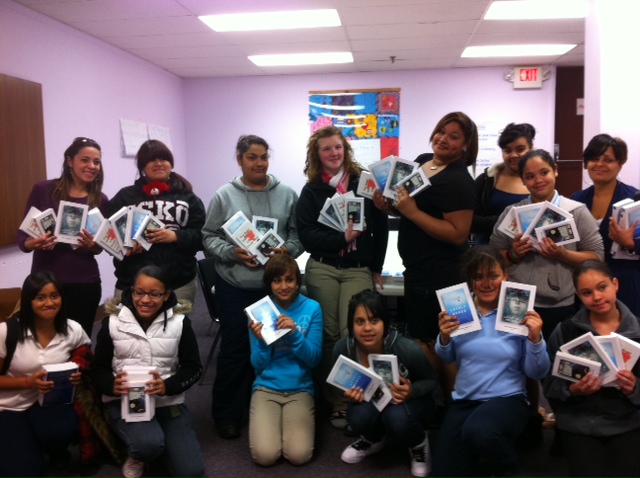
I signed up as a book giver the morning I first heard about World Book Night, and I selected a YA novel called Wintergirls by Laurie Halse Anderson as my title to share with others.  Like all of Anderson's books, it's a powerful and sensitively told story that realistically depicts teen situations without ever talking down to them. For my location, I chose Girls, Inc.of Holyoke, MA, where my part-time co-worker, Sarah, works as her day job. She and I both signed up to give books away to their teen program, and Odyssey co-owner Joan Grenier also went with me to share one of her favorite books.  When we asked for a show of hands for how many of the girls in the room loved reading, only a few went up, but there were lots of squeals of excitement when we actually started distributing the books to the girls. I even overheard a small group of them trying to decide which book they were all going to start that night so that they could read it together. Now that is what World Book Night is all about!
Girls Inc.
~Emily

Tuesday, April 17, 2012

Holy Pulitzer, Batman!

Yesterday was an important day in American letters.  You see, it was the day the Pulitzer Prizes were announced.  For everything except fiction, that is. You know, the division that more readers care about than any other.  No biggie.

What's the deal, Pulitzer Committee People? While the official word is that the committee couldn't reach consensus, the rumors started flying right away yesterday that the committee didn't think any book was worthy of the prize. That's not the kind of elitist publicity anybody wants. (And of course, by "anybody" I mean me...and readers & booksellers who agree with me.)

Seriously, though.  What gives?  I understand that it's hard to reach consensus when three (and I probably ought not to get started on why there were only three titles short listed) books are so vastly different.  But yoo-hoo, Pulitzer Committee People? You're the ones who created the short list to begin with.  The decision was only as difficult as you made it for yourselves. I imagine there's also a lot of pressure to make the "right" decision as literary tastemakers, establishing one book above all others as being worthy of our posterity.

Which, in my view, is all the more reason to actually make a decision.  Nobody else in the real world can get by with just withholding the award when the decision-making process is too preciously difficult.  Why can they?

I don't happen to agree with the three finalists that the committee picked, but that's neither here nor there.  I would have preferred to see Teju Cole's Open City win this prize, as to my mind, it was the finest book "dealing with American life" published last year.

What about you?  What are your thoughts on the omission this year for the fiction prize? What do you wish would have won?

~Emily

Tuesday, April 3, 2012

Grave Mercy by Robin LaFevers

So, this is Tuesday, which means Day-of-Awesome-Book-Releases, and today I want to mention a book that both Marika and I have read.  It's called Grave Mercy, written by Robin LaFevers, which is the first book in the His Fair Assassin series. Marika was lucky enough to get a manuscript direct from the publisher, while I had to content myself with a plain bound galley given away at the New England Independent Booksellers Association last fall.  No matter, because the tagline is so groovy that I knew that I would have to read it right away: Why be the sheep when you can be the wolf? Why, indeed.

It's a rollicking good read, set in 15th century Brittany.  Ismae, marked from birth as the devil's child, passes from the hands of an abusive father to those of an abusive husband without so much as a by-your-leave, but a mysterious person comes to her rescue that eventually leads to convent of St. Mortain, one of the old gods of yore. There Ismae learns the dark arts and becomes assassin and handmaiden to Death himself.  Yeah, that's right.  Did I mention the part where I said it was rollicking? And outrageously fun?  And sinfully distracting from any real world problems you might be experiencing?

But you know the best part?  Marika read the manuscript so early and liked the book so much that her blurb is featured on the back of the dust jacket!  She says, "A romance full of intrigue, poison, and ultimately finding one's way, His Fair Assassin will be a trilogy readers of all ages will gobble up."

Because the Odyssey loves this book so much the publisher, Houghton Mifflin, has given us t-shirts and buttons to give away to everybody who purchases a copy of Grave Mercy, while supplies last.  The red tees and the white buttons both feature the tagline, Why be the sheep when you can be the wolf?

~Emily

Friday, March 9, 2012

Not Your Father's Nonfiction

Here are a pair of brand-new nonfiction books that I've read recently and recommend; I mostly read fiction, and when I do delve into the nonfiction world it's usually of the narrative variety, but these two are outside my usual reading realm. That being said, they were both absolutely fascinating!

The Lifespan of a Fact by John D’Agata and Jim Fingal.  This book is endlessly fascinating!  I had no idea until I read The Lifespan of a Fact exactly what happens behind the scenes of any responsibly published nonfiction piece. This book was born out of an article by John D'Agata that had a few too many factual inaccuracies to get published by mainstream periodicals. Enter Believer magazine, who was willing to publish the article as long as they could determine where facts left off and fiction began. They put their staff fact checker Jim Fingal on the job, and some years later, the article was finally published. Now Norton has published this wonderful behind-the-scenes book, with D'Agata's article intact, printed in black, and surrounded by the fact checking correspondence, much of which is printed in maroon.  It’s clear to me after reading this book that the unnamed fact checkers are the unsung heroes of the publishing world, no matter where we draw the line between journalism and creative nonfiction, and I’ll never take them for granted again. Take a look at this book that is both intriguing to read and a beauty to behold. 

The Storytelling Animal: How Stories Make Us Human by Jonathan Gottschall.  I was surprised upon picking up this book to see how much our lives are defined by story: there are the expected books of course, but also tv, movies, jokes, commercials, lies, gathering ‘round the water cooler, and even sports events; really, the list goes on. Gottschall delves into the fascinating evolutionary, cultural, biological, and even neurological reasons why our species is defined by our storytelling, both communal and individual.  This is by far the most compelling non-narrative nonfiction I’ve read in simply ages, and what’s more, it should be required reading for every single reader and writer out there. This book will be published by Houghton Mifflin Harcourt in a few short weeks, but it's available for pre-order now through our website or by calling the store. 

Tuesday, March 6, 2012

Terrific Tuesday: Song of Achilles by Madeline Miller

We've been madly busy updating our new website and selling Rachel Maddow tickets (hurry--they're almost sold out!), but I couldn't let one of my favorite spring books go unremarked on the blog today.


Wow.  Amazing. Stupendous.  Beautiful.  Heartbreaking.  

Okay, is that enough of a review for debut novel The Song of Achilles, by classics scholar Madeline Miller?  Because I feel that anything else I say about it won't do it justice.  It's astonishing.  The writing is marvelous. The characters, like Athena from her father's head, leap fully-formed from their pages.  

All right, I'll at least try to tell you what this book is all about.  In Miller's words, from the back of the advance reading copy I read: "I had always been especially moved by Achilles, and his desperate grief over the loss of his companion Patroclus. But who was Patroclus? I searched the ancient texts for every mention of his name and discovered an amazing man: exile and outcast, loyal and self-sacrificing, compassionate in a world where compassion was in short supply.  I had not thought The Iliad had a love story; I was wrong."

Song of Achilles, then, is the story of Achilles and Patroclus, narrated by the latter.  It's a love story and a war story, and these twin narratives weave in and around each other to the point that they're impossible to separate. This is like no book I've read before! I never would have thought that there was any book that could both keep me up all hours to finish it AND send me straight to the bookstore to purchase a copy of The Iliad to read back-to-back with it. This book is beautifully imagined and written. Clearly the Greek classics are NOT dead, not with Madeline Miller at the helm. Brava! 

On a completely random sidenote: the character of Odysseus is *exactly* like what Remus Lupin would have been like, had he been sorted into Slytherin.  So yes, Odysseus is the amalgamation of my favorite two DADA teachers!

I raved about this book to my husband, which piqued his interest.  Then I forced suggested that he read it on vacation last week.  He did and he was a bloody mess about it.  The story engaged him to the point that he was distant over dinner conversation.  And forget about talking to him in the wake of the conclusion--he was a weeping shell of a man* over breakfast that morning!  I trust I don't really give anything away when I remind readers that Greek stories are usually tragic or comic, and that this one ain't comic, and we know what happens in tragedies. 

Now I'm off to go read Homer and his many epithets.... 


Madeline Miller will be at the Odyssey on Wednesday, March 21, at 7:00pm.  We hope to see you there!

*not that there's anything wrong with being a weeping shell of a man, or the fact that it was pretty much hard to differentiate that morning from any other day, given that weeping is actually a distinguishing feature of my gentle-souled DH. Hey--that's not a bad epithet, come to think of it!


~Emily

Monday, February 13, 2012

Audio book review: Juliet by Anne Fortier


I actually borrowed this audio book from my mother, for whom I had bought it about a year ago when I saw it on the bargain table at my bookstore.  When I was visiting her over the Christmas hols I noticed that she hadn't listened to it yet, so I helped myself to it. Much as I love David Sedaris and Bill Bryson, I was growing a mite weary of re-listening to their audios on my daily commute, week in and week out.

The story turned out to be surprisingly satisfying, not least because Cassandra Campbell is a very good reader for this story.  I did think that it was a touch over-long, and if I had been reading the physical book I definitely would have skimmed over a good bit of it, but despite that, I give it a solid recommendation.

There are two storylines that eventually come together; one is a modern day young woman named Julie Jacobs, an American who travels to Siena to track down a mysterious inheritance that her mother may have died trying to protect, and the other is the story of Giulietta Tolomei, whose doomed love for Romeo Mariscotti haunted 14th-century Siena and was the inspiration for Shakespeare's famous play. I far more enjoyed the earlier storyline, with its intrigues and betrayals, than the modern one, where Julie seems a little whiny and ineffective.

Medieval curses, hidden statues, lying scoundrels, mystical rites, horse races, precious heirlooms, family feuds, the Mafia, and yes, two pairs of star-cross'd lovers, all have their roles to play, and while most readers (or listeners) won't have much trouble guessing the various plot twists, there's no denying that this is a frolicsome book.

Now, of course, I have to plan a trip to Siena to visit all of the fabulous places described in such loving detail and I've got an unanswerable hankering to delve into more books with an Italian setting.  It's been years since my one and only visit to that country and this book makes me yearn to return.


~Emily

Thursday, February 9, 2012

They Don't Get Better Than This: The Fault in Our Stars

I met John Green a couple of weeks ago when he was participating on a panel for Winter Institute and was one of the big draws at the author receptions.  Up until then, I had only read Will Grayson, Will Grayson, a book that he cowrote with David Levithan, and while I knew he was a beloved author, I really had no clear idea why until that time in New Orleans.  On his panel he kept talking about his horrifically tragic books, but he himself was so damn funny (and WG, WG tipped decidedly toward the funny end of the scale, not the tragic one) that it was difficult for me to feature.

I left work on Thursday with a signed copy of The Fault in Our Stars tucked under my arm, winging a comment back to my colleague Marika as I left that I was looking forward to the emotional ride. Little did I know! I was barely into Chapter One before the bed was shaking with laughter and my husband sniffed at me from over the top of his own, decidedly-less-funny book,  The Crossing by Cormac McCarthy. My cats didn't seem to mind, though my sweet Murray did start licking my face when the laughter abruptly shifted to tears. I'm telling you, this book chewed up my heart and spit it back out again, but I had an absolutely Grand Time for the duration.

You know the movie Steel Magnolias?  I love that movie, not least for its eminent quotability, and one of the first lines I committed to memory was one of Dolly Parton's: "Laughter through tears is my favorite emotion." Well, this book is the pure-dee embodiment of that sentiment.  There were times my shoulders were a-shakin' and I'd be very hard-pressed to determine if it were more from the tears or more from the laughter, for I could suppress neither for very long.

Probably most of you who are reading this review know exactly what this book is about, but for my mom and my husband, and those of you who don't, perhaps, have your fingers on the pulse of YA publishing, here's a short summary: two teenagers meet and fall in love.  So far, so good.  But it's where they meet that shapes this book's content--at a support group for teens with cancer. The reader absolutely knows from the beginning that the book cannot end well, but that doesn't keep the reader from hanging herself with the hope rope. (Or maybe that's just me.) Augustus and Hazel wouldn't be your typical teens even without their missing or weakened body parts.  They're smart, curious, snarky, and introspective. Their cancer has taken them beyond politeness to that realm where fools are not suffered gladly and where the concept of pussyfooting around topics other (read: normal) people find uncomfortable is unfathomable.

The dialogue is exactly what dialogue should be in real life, if only we got to rehearse and make it perfect yet authentic. The pathos in the book is a fitting tribute to the title's source: nothing less venerably tragic than Shakespeare's Julius Caesar ("The fault, dear Brutus, is not in our stars,/ But in ourselves").

There's book talk, video games, a friend who goes blind, some mild vandalism, a trip to Amsterdam, Two Very Important Venn diagrams, and an asshole of an author, and throughout it all the book boils down to narrative perfection. My two main critiques of the book have nothing to do with the content and everything to do with design: 1) the cover design is not very good, and in fact it's hard to read the text underneath the white cloud, and (2) The lovely-to-look-at typeface which is also, in fact, easy to read, is never identified.

Really, I cannot recommend this book enough.  Just read it, y'all!

~Emily